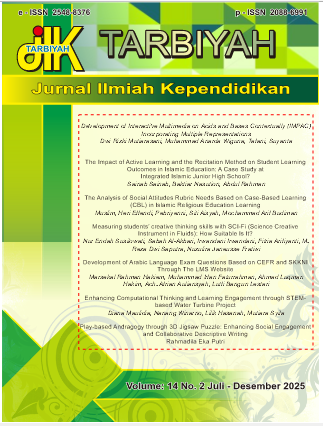
Development of Arabic Language Exam Questions Based on CEFR and SKKNI Through The LMS Website
DOI:
https://doi.org/10.18592/tarbiyah.v14i2.17696Keywords:
language evaluation, CEFR, SKKNI, LMS moodle, arabicAbstract
This study aims to develop Arabic language test questions based on the Common European Framework of Reference for Languages (CEFR) and the Indonesian National Work Competency Standards (SKKNI), and to present them online via the Learning Management System (LMS). This study is part of an effort to develop an Arabic language evaluation instrument that is more communicative, accountable, and aligned with global and national needs. The instrument development process was carried out using the ADDIE model across the analysis, design, development, implementation, and evaluation stages. The test was then administered to 212 students. The evaluation revealed a decline in CEFR level achievement from pre-test to post-test, indicating a more accurate measurement of Arabic language proficiency. Interviews with 57 participants confirmed that the test items were perceived as more challenging and that they reflected real Arabic language use. These findings demonstrate the success of integrating the CEFR and SKKNI to produce a more targeted and high-quality Arabic language evaluation instrument.
References
Azwar, S. (2017). Reliabilitas dan Validitas. Pustaka Pelajar.
Bachman, L. F., & Palmer, A. S. (2010). Language Assessment in Practice: Developing Language Assessments and Justifying Their Use in the Real World. Oxford University Press.
Beinhoff, B. (2019). The Common European Framework of Reference for Languages: A European framework for foreign language speech development. Language Value, 6(1). https://doi.org/10.6035/LanguageV.2014.6.5
Demirdöven, G. H. (2025). CEFR updates (2020)-based next-gen immersive learning in 5 steps. Frontiers in Education, 10. https://doi.org/10.3389/feduc.2025.1567249
Dick, W., Carey, L., & Carey, J. O. (2015). The Systematic Design of Instruction. Vital Source (for Pearson) VST.
Fawaid, A., Solehah, L. Y., & Assya’bani, R. (2024). Structured Infographic Worksheet through Lesson Study in Improving Madrasa Students’ Writing Skills in Indonesian Language Subject. Tarbiyah : Jurnal Ilmiah Kependidikan, 13(2), 273–290. https://doi.org/10.18592/tarbiyah.v13i2.13849
Gamage, S. H. P. W., Ayres, J. R., & Behrend, M. B. (2022). A systematic review on trends in using Moodle for teaching and learning. International Journal of STEM Education, 9(1), 9. https://doi.org/10.1186/s40594-021-00323-x
Gupta, K. (2023). Validity and Reliability of Students’ Assessment: Case for Recognition as a Unified Concept of Valid Reliability. International Journal of Applied & Basic Medical Research, 13(3), 129–132. https://doi.org/10.4103/ijabmr.ijabmr_382_23
Ibrahim, A., & Alhosani, N. (2020). Impact of language and curriculum on student international exam performances in the United Arab Emirates. Cogent Education, 7(1). https://doi.org/10.1080/2331186X.2020.1808284
Kremmel, B., Eberharter, K., Konrad, E., & ... (2023). The CEFR Companion Volume: Opportunities and challenges for language assessment. Didaktik Slawischer …, 3. https://doi.org/10.48789/2023
Lord, F. M., & Novick, M. R. (1968). Statistical Theories of Mental Test Scores. Addison-Wesley.
Mahmudah, M. (2018). Pengaruh Media Audio Terhadap Keterampilan Menyimak dan Berbicara Bahasa Arab. Jurnal Tarbiyah : Jurnal Ilmiah Kependidikan, 7(2). https://doi.org/10.18592/tarbiyah.v7i2.2219
Maulani, A., Ayu, S. M., Dermawan, O., & Akmansyah, M. (2021). The Development of Android-Based Islamic Education Learning Media. Tarbiyah : Jurnal Ilmiah Kependidikan, 10(1), 35. https://doi.org/10.18592/tarbiyah.v10i1.4410
Messick, S. (1989). Validity. In R. L. Linn (Ed.), Educational Measurement. Macmillan Publishing Co.
Muliana, N., Pada, A. U. T., & Nurmaliah, C. (2020). Content validity of conation assessment. Journal of Physics: Conference Series, 1460(1), 012057. https://doi.org/10.1088/1742-6596/1460/1/012057
Muradi, A., Mubarak, F., Permana, F., Hidayat, Y., & Wekke, I. (2021). Revitalization of the Existence of Arabic in Indonesia. SSRN Electronic Journal. https://doi.org/10.2139/ssrn.3767448
Nagai, N., Birch, G. C., Bower, J. V., & Schmidt, M. G. (2020). The CEFR and Practical Resources (pp. 1–36). https://doi.org/10.1007/978-981-15-5894-8_1
Nawai, R., & Said, N. E. M. (2020). Implementation Challenges of Common European Framework Reference (CEFR) in a Malaysian Setting: Insights on English Teachers’ Attitude. International Journal of Academic Research in Business and Social Sciences, 10(7). https://doi.org/10.6007/IJARBSS/v10-i7/7394
Oktapianti, S. (2024). TOEFL Score of Tadris Chemistry Students at UIN Antasari in Achievement of CEFR Standard. Tarbiyah : Jurnal Ilmiah Kependidikan, 13(1), 55–63. https://doi.org/10.18592/tarbiyah.v13i1.11417
Pirooz, H., & Saber, Khaghaninejad. M. (2023). An Investigation into the Interrelation of the First and the Foreign Languages Reading Comprehension Proficiencies: Linguistic Interdependence Versus Balance Hypotheses. Jordan Journal of Modern Languages and Literatures, 15(2), 699–711. https://doi.org/10.47012/jjmll.15.2.17
R. Taufiqurrochman & Lubna Farah. (2024). Transitioning from Monodisciplinary in Arabic Education: Indonesian Insights. EVOLUTIONARY STUDIES IN IMAGINATIVE CULTURE, 915–924. https://doi.org/10.70082/esiculture.vi.745
Rakhlin, N. V., Aljughaiman, A., & Grigorenko, E. L. (2021). Assessing language development in Arabic: The Arabic language: Evaluation of function (ALEF). Applied Neuropsychology: Child, 10(1), 37–52. https://doi.org/10.1080/21622965.2019.1596113
Reswari, G. P. A. (2025). Adopting A Service-Learning Approach in Developing English for Specific Purposes Communicative Competence in Indonesia: A Sociocultural Theory-Based Mediational Study Girindra Putri Ardana Reswari A thesis submitted for the degree of Doctor of Philosophy (Issue February).
Retnawati, H. (2016). Proving content validity of self-regulated learning scale (The comparison of Aiken index and expanded Gregory index). REID (Research and Evaluation in Education), 2(2), 155–164. https://doi.org/10.21831/reid.v2i2.11029
Robbani, A. S., Nurdianto, T., Annafiri, A. Z., Haqqy, A. M., & Irfan, I. (2023). Tren penelitian dan tantangan penerapan Common European Framework of Reference for Languages (CEFR) di Indonesia. Diglosia: Jurnal Kajian Bahasa, Sastra, Dan Pengajarannya, 6(4), 1011–1026. https://doi.org/10.30872/diglosia.v6i4.736
Ruhendi, A., & Kosim, N. (2022). Developing Arabic Language Teachersâ€TM Competence and Performance through Teacher Profession Education. Jurnal Pendidikan Islam, 8(1), 37–50. https://doi.org/10.15575/jpi.v8i1.18243
Runnels, J. (2019). Impact of the Common European Framework of Reference—A bibliometric analysis of research from 1990-2017. CEFR Journal - Research and Practice, 1, 18–32. https://doi.org/10.37546/JALTSIG.CEFR1-2
Sari, I. (2021). Error Analysis in the Work of Novice Indonesian Translators.
Sari, Indah. 2020. Error analysis of economic terms in the work of indonesian novice translation. Revista de lenguas para fines especÃficos 26.1, pp. 122-132 · http://dx.doi.org/10.20420/rlfe.2020.317
Shaalan, S. (2017). Reliability and Validity of Four Arabic Language Tests: A comparison of performance of Qatari School-aged children with and without language impairment. Arab Journal of Applied Linguistics, 2(1 SE-), 20–48.
Subari, A. J., & Siswanto, S. (2024). Development of Accounting Learning E-Modules with a Guided Inquiry Approach to Increase Student Learning Motivation in Accounting Computer Subjects. Tarbiyah : Jurnal Ilmiah Kependidikan, 13(2), 209–227. https://doi.org/10.18592/tarbiyah.v13i2.13757
Wahba, K., Taha, Z. A., & England, L. (Eds.). (2014). Handbook for Arabic Language Teaching Professionals in the 21st Century. Routledge. https://doi.org/10.4324/9780203824757
Wahyuni, T., Rahayu, W., & Naga, D. S. (2024). Validity and reliability of the situational judgment test instrument for assessing the ‘Pancasila’ student profile. Cogent Education, 11(1), 2439157. https://doi.org/10.1080/2331186X.2024.2439157
Wang, J. (2024). Teaching Reform Program of Integrated Practice Course for Automotive Majors Based on ADDIE Model. Applied Mathematics and Nonlinear Sciences, 9(1), 20242135. https://doi.org/10.2478/amns-2024-2135
Widyaningsih, S. W., Yusuf, I., Prasetyo, Z. K., & Istiyono, E. (2021). The Development of the HOTS Test of Physics Based on Modern Test Theory: Question Modeling through E-learning of Moodle LMS. International Journal of Instruction, 14(4), 51–68. https://doi.org/10.29333/iji.2021.1444a
Xu, H., & Li, G. (2024). CEFR-informed learning, teaching and assessment: A practical guide. Studies in Second Language Learning and Teaching, 14(2), 365–370. https://doi.org/10.14746/ssllt.32669
Yasmadi, Y., Husna, I., Arsya, F., Rahmah, A., Kustati, M., & Perrodin, D. D. (2024). Insights from a State Islamic University on Arabic Education as a Catalyst for Religious Moderation in Indonesia. International Journal of Language Education, 8(3). https://doi.org/10.26858/ijole.v8i3.66496
Yuanti, E. E., & Vardhani, N. K. (2021). Penyusunan Kurikulum Blok Bahasa Inggris Vokasional. Jurnal Vokasi Indonesia, 9(1). https://doi.org/10.7454/jvi.v9i1.219
Zhu, A., Mofreh, S. A. M., & Salem, S. (2023). The Application of Language Proficiency Scales in Education Context: A Systematic Literature Review. Sage Open, 13(3), 21582440231199692. https://doi.org/10.1177/21582440231199692
Downloads
Published
How to Cite
Issue
Section
License
Copyright (c) 2025 Marsekal Rahman Hakiem; Muhammad Irfan Faturrahman; Ahmad Luqman Hakim, Ach. Afrian Auliansyah, Lutfi Bangun Lestari

This work is licensed under a Creative Commons Attribution 4.0 International License.
Authors retain copyright and grant the journal right of first publication with the work simultaneously licensed under a Creative Commons Attribution 4.0 International License that allows others to share the work with an acknowledgment of the work's authorship and initial publication in this journal.