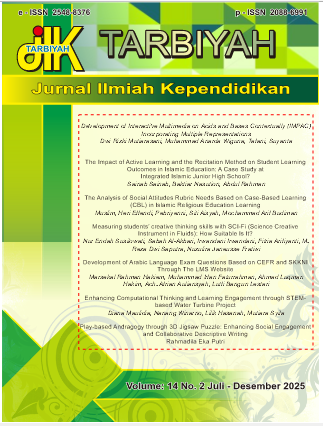
Play-based Andragogy through 3D Jigsaw Puzzle: Enhancing Social Engagement and Collaborative Descriptive Writing
DOI:
https://doi.org/10.18592/tarbiyah.v14i2.16030Keywords:
3D jigsaw puzzle, collaborative writing, descriptive writing, play-based andragogy, social engagementAbstract
Play-based approach, traditionally reserved for childhood education, has demonstrated substantial potential in emerging adulthood learning, aiding in the cultivation of creativity, critical thinking, and interpersonal communication. This study investigates the efficacy of play-based approach, through 3D jigsaw puzzles, in fostering social interaction and collaborative descriptive writing within andragogy setting. Grounded in experiential and student-centred learning theories, it aligns with the developmental needs of young adults, promoting engagement and holistic growth. The study aimed to explore students’ perceptions of play-based approach and identify patterns of social interaction during collaborative descriptive writing. Conducted at regional branch campus of State Polytechnic of Sriwijaya, this study utilized convenience sampling for one small class consisted with nine freshmens. A mixed-method design was employed through closed-ended questionnaire and non-participative observation to provide a comprehensive analysis. The findings demonstrated that play-based approach enhanced engagement, mitigated stress, and nurtured partnerships through peer support, role specialization, and joint problem-solving which was exerting a positive influence on descriptive writing outcomes. Ultimately, the study suggests that play-based approach can profoundly amplify emerging adulthood education, particularly in collaborative learning. Therefore, this approach could feasibly serve as a constructive foundation for the development of future andragogy curricula.
References
Abdullah, M., Chamid, N., & Khamim, K. (2021). Reorientation of the andragogy concept and its relevance to higher education in Indonesia for answering the global era of information: Critical review of Malcolm Knowles perspective. The 2nd International Conference on Islamic Studies, Ponorogo, Indonesia.
Addinna, A., Ovilia, R., Solusia, C., & Ramadhani, S. (2025). Students’ cognitive, affective, behavioural and social engagement in collaborative writing. Jurnal Bahasa dan Sastra, 12(3), 548–558. https://doi.org/10.24036/jbs.v12i3.129994
Adipat, S., Laksana, K., Busayanon, K., Asawasowan, A., & Adipat, B. (2021). Engaging students in the learning process with game-based learning: The fundamental concepts. International Journal of Technology in Education, 4(3), 542–552. https://doi.org/10.46328/ijte.169
Afrezah, N. N., Azizi, M. R., Alrian, R., Pratiwi, D., & Yulia, Y. (2024). Students' writing skills through collaborative writing and the tendency to work in a group. Journal of Research in Instruction, 4(1), 100-110. https://doi.org/10.30862/jri.v4i1.318
Aguilar, S. F. (2024). Play-based approach concept and development of teaching among kindergarten teachers. European Journal of Education Studies, 11(6), 84–92.
Al-Ani, S.A., Chandla, D., Delieu, J. et al. (2024). Use of 3D foot and ankle puzzle enhances student understanding of the skeletal anatomy in the early years of medical school. Surgical and Radiologic Anatomy, 46, 1429–1438
https://doi.org/10.1007/s00276-024-03439-1
Al-Karadsheh, O., Abutayyem, H., Saidi, A., & Shqaidef, A. (2025). Knowledge acquisition and student perceptions of three teaching methods: a randomized trial of live, flipped, and interactive flipped classrooms. BMC Medical Education, 25, 573. https://doi.org/10.1186/s12909-025-07156-0
Arnett, J. J. (2002). The psychology of globalization. American Psychologist, 57(10), 774– 783. https://doi.org/10.1037/0003-066X.57.10.774
Becker, S. J., & Börnert-Ringleb, M. (2025). Stress and anxiety in schools: A multilevel analysis of individual and class-level effects of achievement and competitiveness. Frontier Education, 9, 1519161. doi: 10.3389/feduc.2024.151
Bøgelund, P., & Nørgaard, B. (2025). Investigating required group dynamics and motivational strategies for high-performance study teams. International Journal of Engineering Education, 36(6), 1833–1849.
https://www.ijee.ie/1atestissues/Vol36-6/11_ijee3991.pdf
Bagley, M. B., Smith, A. G., Morton, D. A., & Chow, C. J. (2022). “I really liked the chance to talk about itâ€: Students’ reflections on the process of completing paper puzzles, a novel active learning activity. Medical science educator, 32(6), 1503–1511. https://doi.org/10.1007/s40670-022-01682-y
Bandura, A. (1977). Social learning theory. Prentice Hall.
Beloyianni, V., Zbainos, D., & Karagianni, M. P. (2024). From mindreading to originality: Exploring the relationship between Theory of Mind and Creativity across the lifespan. British Journal of Developmental Psychology, 42, 215–233. https://doi.org/10.1111/bjdp.12476
Bergdahl, N., & Bond, M. (2022). Negotiating (dis-)engagement in K-12 blended learning. Education and Information Technologies, 27(2), 2635–2660.
https://doi.org/10.1007/s10639-021-10714-w
Blanche, E. I., Chang, M. C., & Parham, L. D. (2024). Experiences of Adult Play. The American journal of occupational therapy, 78(4), 7804185040.
https://doi.org/10.5014/ajot.2024.050436
Bond, M., & Bergdahl, N. (2022). Student engagement in open, distance, and digital education. In Handbook of Open, Distance and Digital Education (pp. 1–16). Springer Nature Singapore. https://doi.org/10.1007/978-981-19-0351-9_79-1
Carmona, M., De los Santos-Roig, M., Mata, S., & Serrano, F. (2025). Effectiveness of a comprehensive game-based intervention for writing skills. Reading and Writing. https://doi.org/10.1007/s11145-025-10636-w
Casanova-Mata, I. (2023). Enhancing English Acquisition: Effects of among us Game-
Based Gamification on Language Competence, Motivation, Attention, and Attitude towards the English Subject. Education Sciences, 13(11), 1094.
https://doi.org/10.3390/educsci13111094
Chairinkam, J., & Yawiloeng, R. (2021). Peer scaffolding behaviors in an English as a foreign language writing classroom. Asian Journal of Education and Training, 7(4), 226-234.
Chun, J., & Cennamo, K. (2022). A theoretical model of peer learning incorporating scaffolding strategies. International Journal of Teaching and Learning in Higher Education, 33(3), 385–397. https://www.isetl.org/ijtlhe/pdf/IJTLHE4106.pdf
Cohen, E., Davis, A. J., & Taylor, J. (2023). Interdependence, bonding and support are associated with improved mental wellbeing following an outdoor team challenge. Applied psychology. Health and well-being, 15(1), 193–216. https://doi.org/10.1111/aphw.12351
Córdova, A., Caballero-GarcÃa, A., Drobnic, F., Roche, E., & Noriega, D. C. (2023). Influence of stress and emotions in the learning process: The example of COVID-19 on university students: A narrative review. Healthcare (Basel, Switzerland), 11(12), 1787. https://doi.org/10.3390/healthcare11121787
Cornaggia, A., Bianco, F., Castelli, I., & Belacchi, C. (2024). Assessing metarepresentational abilities in adolescence: An exploratory study on relationships between definitional competence and theory of mind. Frontiers in psychology, 15:1456432.
Costantini, A., Bakker, A. B., & Scharp, Y. S. (2025). Playful study design: A novel approach to enhancing student well-being and academic performance. Educational Psychology Review, 37, 47.
https://doi.org/10.1007/s10648-025-10022-6
Dean, S. N., & Wenner, J. A. (2025) Patterns and representation in play-based learning: a systematic meta-synthesis of empirical studies in K-13+ settings. Frontier Education, 10:1557001. doi: 10.3389/feduc.2025.1557001
Doherty, M. J., Wimmer, M. C., Gollek, C., & Robinson, E. J. (2021). Piecing together the puzzle of pictorial representation: How jigsaw puzzles index metacognitive development. Child Development, 92(1), 205–221.
https://doi.org/10.1111/cdev.13359
Drouet, O. C, Lentillon-Kaestner, V., & Margas, N. (2023). Effects of the jigsaw method on student educational outcomes: Systematic review and meta-analyses. Frontiers in Psychology, 14, 1216437.
https://doi.org/10.3389/fpsyg.2023.1216437
Dzukhriyah, S., & Rini, S. (2023). Genre-based approach effectiveness in writing descriptive text. LITE: Jurnal Bahasa, Sastra, Dan Budaya, 19(2), 120–126. https://doi.org/10.33633/lite.v19i2.8520
Elsawah, W. (2025). Exploring the effectiveness of gamification in adult education: A learner-centric qualitative case study in a Dubai training context. International Journal of Educational Research Open, 9, 100465.
https://doi.org/10.1016/j.jae.2025.01.001
Fadzil, M. N., & Osman, S. (2025). Scoping the landscape: Comparative review of collaborative learning methods in mathematical problem-solving pedagogy. International Electronic Journal of Mathematics Education, 20(2), em0820. https://doi.org/10.29333/iejme/15935
Fitria, R. Trisnawati, I. K., & Mulyani, M. (2023). What Indonesian EFL Learners Perceive of Collaborative Writing: Experience in Writing Essays Online. English Education Journal, 14(1), 493-516.
Gao, J., & Zuo, Y. (2025). Mechanisms of foreign language learning anxiety and enhancement strategies among Chinese tertiary students: A grounded theory approach. Frontiers in Psychology, 15, Article 1512105.
https://doi.org/10.3389/fpsyg.2024.1512105
Granone, F., & Pollarolo, E. (2025). Facilitating children’s communication in problem-solving activities with a coding toy: Teachers’ semiotic mediation in early childhood education and care. Frontier Psychology, 15,1426165.
Grijpma, J. W., Ramdas, S., Broeksma, L., Meeter, M., Kusurkar, R. A., & de la Croix, A. (2024). Learning from the experts: Stimulating student engagement in small-group active learning. Perspectives on medical education, 13(1), 229–238.
https://doi.org/10.5334/pme.1245
Guo, R., Jantharajit, N., & Thongpanit, P. (2024). Enhancing analytical and critical thinking skills through reflective and collaborative learning: A quasi-experimental study. Journal of Education and Educational Development, 11(2), 200–223. https://doi.org/10.22555/joeed.v11i2.1166
Gusta, W., Putri, D. M., & Permata, R. (2024). The playful path: Analyzing gamification and motivation in EFL grammar teaching-Learning process. JOINT: Journal of Inspirational English Language Teaching, 1(1), 45–54.
https://doi.org/10.33830/joint.v1i1.10286
Harris, S., Massey, S., Cordner, C., & Scott Jones, J. (2024). Less anxious, more confident: The use of playful pedagogy to support student learning of quantitative methods. Proceedings of the 10th International Conference on Higher Education Advances (HEAd’24). https://doi.org/10.4995/HEAd24.2024.17293
Heljakka, K. (2023), Building playful resilience in higher education: Learning by doing and doing by playing. Frontier Education, 8,1071552.
doi: 10.3389/feduc.2023.1071552
Ho, W. W. Y. (2022). Influence of play on positive psychological development in emerging adulthood: A serial mediation model. Frontiers in psychology, 13, 1057557. https://doi.org/10.3389/fpsyg.2022.1057557
Hou, R., Jin, L., He, J., & Wang, J. L. (2025. Peer support and learning outcomes in “Study With Me†among generation Z college students: Mediating roles of motivation, test anxiety, and self-efficacy. Frontier Psychology, 16, 1582857.
Hosokawa, A., & Kitagami, S. (2024). Visuospatial perspective-taking of a protagonist during narrative comprehension: the effects of task load and individual differences in visuospatial working memory. Frontiers in psychology, 15, 1379472. https://doi.org/10.3389/fpsyg.2024.1379472
Jasrial, J., Saputra, A., & Rifma, R. (2023). Improving learning outcomes: The effectiveness of e-book reading literacy based in learning management psychology. Jurnal Cakrawala Pendidikan, 42(3).
https://doi.org/10.21831/cp.v42i3.53033
Khairatunni’mah, S. M., & Latipah, E. (2024). Exploring transitions: Young adult development from a psychological perspective. International Journal of Educatio Elementaria and Psychologia, 1(3), 158-168.
https://doi.org/10.70177/ijeep.v1i3.1087
Lee, J.W.Y., Low, L.X.T., Ong, D.W. et al. (2025). An activity theory approach to analysing student learning of human anatomy using a 3D-printed model and a digital resource. BMC Medical Education 25, 553.
https://doi.org/10.1186/s12909-025-07172-0
Latiff, D. I. A., Kamal, S., Latif, A. S. S. S., & Bakar, M. N. A., & Zambri, W. A. A. M. (2024). From Play to Practice: The Role of Game-Based Learning in Facilitating Learning Motivation, Enjoyment and Performance in Classroom. International Journal of Academic Research in Progressive Education and Development, 13(3), 2377–2390. http://dx.doi.org/10.46886/IJARPED/v13-i3/18573
Levine, S. L., Holding, A. C., Milyavskaya, M., Powers, T. A., & Koestner, R. (2021). Collaborative autonomy: The dynamic relations between personal goal autonomy and perceived autonomy support in emerging adulthood results in positive affect and goal progress. Motivation Science, 7(2), 145-152. https://doi.org/10.1037/mot0000209
Li, H. (2025). Impact of collaborative learning on student engagement in college English programs: Mediating effect of peer support and moderating role of group size. Frontiers in psychology, 16, 1525192.
https://doi.org/10.3389/fpsyg.2025.1525192
Li, Z., Hampson, P., Thurston, A., & O’Keeffe, J. (2025). The outcome of peer tutoring for second language (L2) writing: A meta-analysis. International Journal of Educational Research Open, 8, 100422.
https://doi.org/10.1016/j.ijedro.2024.100422
Lintner, T., Diviák, T., & Nekardová, B. (2024). Interaction dynamics in classroom group work. Social Networks, 79, 14-24.
https://doi.org/10.1016/j.socnet.2024.05.002
Lubbers, K., Cadwallader, J., Lin, Q., Clifford, C. & Frazier, L. D. (2023). Adult play and playfulness: A qualitative exploration of its meanings and importance. The Journal of Play in Adulthood, 5(2), 1-19. https://doi.org/10.5920/jpa.1258
Marceiras, R., Feijoo, J., Alvonsin, V., & Perez-Rial, L. (2025). Effectiveness of active learning techniques in knowledge retention among engineering students. Education for Chemical Engineers, 51, 1-8.
https://doi.org/10.1016/j.ece.2025.01.003
Masura, F., & Widiati, U. (2020). Exploring the effects of collaborative writing on students’ argumentative essays and their perceptions about its implementation. In Proceeding of English Language Teaching and Research (ELTAR), 3(1), 41-44.
Nasution, M., Putri, R. E., dan Agustina, M. (2024). The effect of TAI (Team-assisted individualization) method on mechanical engineering students’ achievement in writing narrative text. Jurnal Pendidikan Tambusai, 8(2), 17865– 17876. https://doi.org/10.31004/jptam.v8i2.14928
Nazilah, M. B., Rahmah, M. F., Aliza, N., & Salianty, S. (2022). The use of educational puzzle games for the development of cognitive abilities of children aged 5–6 years. GENIUS Indonesian Journal of Early Childhood Education, 3(2), 151–162. https://doi.org/10.35719/gns.v3i2.102
Nguyen, L., Murphy, K., & Andrews, G. (2024). Older Adults’ Perceptions, Experiences, and Preferences of a Gamified Cognitive Training Program. International Journal of Human–Computer Interaction, 41(14), 8624–8638.
https://doi.org/10.1080/10447318.2024.2413283
Parker, R., Thomsen, B. S., & Berry, A. (2022). Learning through play at school – A framework for policy and practice. Frontier Educational, 7:751801.
Pham, V. P. H. (2023). The impacts of collaborative writing on individual writing skills. Journal of Psycholinguistic Research, 52(4), 1221–1236.
Por, F. P., Ong, C. S. B., Ng, S. K., Eak, A. D. (2025). A bibliometric analysis on gamifying adult learning: Past, present and future trends of learner-centered pedagogies. Interactive Technology and Smart Education, 22(1). 43–60.
https://doi.org/10.1108/ITSE-11-2023-0226
Putri, R. E. (2025a). English for hospitality: A representation of oral communication practices in food and beverage (F&B) services in the British mini-series “Boiling Pointâ€. IJELR: International Journal of Education, Language, and Religion, 7(1), 75-90. https://doi.org/10.35308/ijelr.v7i1.11783
Putri, R. E. (2025b). Retrospective study: Integrating English for medical purposes and edutainment through English-subtitled K-drama “Daily dose of sunshine†to enhance nursing students’ psychiatric vocabulary. SALEE: Study of Applied Linguistics and English Education, 6(2), 338–357.
https://doi.org/10.35961/salee.v6i2.1655
Putri, R. E. (2025c). Vocational English Grammar: Computer Engineering Students’ Misformation Error Analysis on Auxiliary Verbs of Passive Voice in TOEIC Reading. Jurnal Sosial Humaniora dan Pendidikan (JSHP), 9(1), 1-11. https://doi.org/10.32487/jshp.v9i1.2324
Orakbaeva, S. (2025). The effectiveness of play-based methods in teaching language to young learners. (2025). Modern Education and Development, 30(1), 415- 418. https://scientific-jl.com/mod/article/view/25365
Rezeki, Y. S., & Rahmani, E. F. (2021). The implementation of collaborative writing technique to improve students’ writing performance and soft skill. Voices of English Language Education Society (VELES), 5(2), 81–94.
https://doi.org/10.29408/veles.v5i2.3614
Revutska, S. (2024). Writing skills improvement and development of critical thinking. Teaching Languages at Higher Institutions, 45(5). https://doi.org/10.26565/2073-4379-2024-45-05
Sappaile, B. I., Mokay, M. M., Supendi, D., Smas, M. H., & Rais, R. (2025). Analysis of the effectiveness of collaborative learning in enhancing academic achievement in junior high schools. International Journal of Educational Research Excellence (IJERE), 4(1), 225-231. https://doi.org/10.55299/ijere.v4i1.925
Sari, W., & Haji, S. (2021). Improving conceptual understanding through inquiry learning by using a jigsaw method in abstract algebra subject. Journal of Physics: Conference Series, 1731, Article 012052. https://doi.org/10.1088/1742-6596/1731/1/012052
Shen Z, Lai M and Wang F (2024) Investigating the influence of gamification on motivation and learning outcomes in online language learning. Front. Psychol. 15:1295709. doi: 10.3389/fpsyg.2024.1295709
Suwastini, N. K. A., Puspawati, N. W. N., Nitish, P. K., Adnani, N. L. P. S., & Rusnalasari, Z. D. (2022). Play-based approachfor creating fun language classroom. Lentera Pendidikan: Jurnal Ilmu Tarbiyah dan Keguruan, 25(2), 250- 270.
Tam, A. C. F. (2023). Transforming preschool language teachers’ beliefs of implementing play-based learning in a professional learning community. International Journal of Early Years Education, 31(1), 46-62.
Tang, T., Vezzani, V., & Erikkson, V. (2020). Developing critical thinking, collective creativity skills and motivation through Design Jam. Thinking Skills and Creativity, 37, 100696. https://doi.org/10.1016/j.sbspro.2020.03.001
Villar, E., Real-Deus, E., MartÃnez-López, Z., Mayo, M. E., & Tinajero, C. (2025). Perceived peer support, motivational self-regulation and academic achievement in adolescents. The British journal of educational psychology, 10.1111/bjep.12783. https://doi.org/10.1111/bjep.12783
Vygotsky, L. S. (1978). Mind in society: The development of higher psychological processes. Harvard University Press.
Wahyurianto, I., & Sylvia, S. (2024). Collaborative learning strategy for better reading comprehension in EFL university courses. Journal of English for Academic and Specific Purposes, 7(2), 127–139. https://doi.org/10.18860/jeasp.v7i2.29674
Wonglakorn, P., & Deerajviset, P. (2023). The effects of collaborative process writing approach on Thai EFL secondary school students’ writing skills. Journal: Language Education and Acquisition Research Network (LEARN), 16(1), 495- 522.
Wu, T., Tang, X., Wong, S., Chen, X., Shaffer, C. A., & Chen, Y. (2024). The impact of group discussion and formation on student performance: An experience report in a large CS1 course. arXiv. https://doi.org/10.48550/arXiv.2408.14610
Xu, E., Wang, W., & Wang, Q. (2023). The effectiveness of collaborative problem solving in promoting students’ critical thinking: A meta-analysis based on empirical literature. Humanities and Social Sciences Communications, 10, 16. https://doi.org/10.1057/s41599-023-01508-1
Yoshioka, T., Muto, H., & Saiki, J. (2025) Functional perspectives in mental jigsaw puzzles: Insights from eye-tracking, questionnaire, and behavioral data. PLoS ONE, 20(4): e0321217. https://doi.org/10.1371/journal.pone.0321217
Zakaria, A., & Zakaria, N. Y. K. (2025). The impact of digital game-based learning tools on motivation, engagement, and performance in language education: A systematic literature review. International Journal of Academic Research in Progressive Education and Development, 10(1), 1–15. https://doi.org/10.6007/IJARPED/v10-i1/24954
Downloads
Published
How to Cite
Issue
Section
License
Copyright (c) 2025 Rahmadila Eka Putri

This work is licensed under a Creative Commons Attribution 4.0 International License.
Authors retain copyright and grant the journal right of first publication with the work simultaneously licensed under a Creative Commons Attribution 4.0 International License that allows others to share the work with an acknowledgment of the work's authorship and initial publication in this journal.