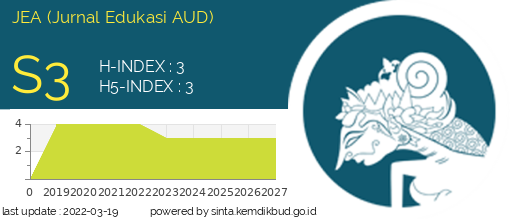
Accreditation
Reviewers play an important role in maintaining the academic quality, integrity, and relevance of manuscripts submitted to JEA (Jurnal Edukasi AUD).
Reviewers are expected to provide objective, constructive, confidential, and timely evaluations. Reviewers should help editors make editorial decisions and help authors improve the quality of their manuscripts.
JEA (Jurnal Edukasi AUD) applies a peer-review process. Each manuscript that passes the initial editorial screening will be reviewed by at least two reviewers with relevant expertise.
Reviewers are selected based on their academic expertise, publication record, research field, and relevance to the manuscript topic.
Reviewers are responsible for evaluating manuscripts carefully and fairly. Reviewers should assess the manuscript based on academic quality, originality, method, analysis, clarity, and contribution to early childhood education studies.
Reviewers must provide clear comments and recommendations to support editorial decisions.
All manuscripts received for review must be treated as confidential documents.
Reviewers must not share, copy, distribute, cite, or discuss the manuscript with others without permission from the editor.
Reviewers must not use unpublished information from the manuscript for personal research, teaching, publication, or other interests.
Reviewers must declare any potential conflict of interest before accepting a review assignment.
A conflict of interest may include personal, academic, institutional, financial, competitive, or collaborative relationships with the authors or their institutions.
If reviewers have a conflict of interest, they should inform the editor and decline the review assignment.
Reviewers should complete the review within the time given by the editor.
If reviewers cannot complete the review on time, they should inform the editor as soon as possible.
If reviewers feel unqualified to review the manuscript, they should decline the review assignment.
Reviewers should evaluate the manuscript based on the following criteria:
Reviewers should pay attention to ethical issues in the manuscript.
For studies involving children, teachers, parents, schools, or early childhood education institutions, reviewers should check whether the manuscript explains ethical considerations, permission, consent, or other relevant ethical procedures.
Reviewers should inform the editor if they find potential ethical problems, plagiarism, data fabrication, duplicate publication, inappropriate authorship, or other forms of academic misconduct.
Reviewers should conduct the review objectively.
Personal criticism of the author is not allowed. Review comments should focus on the manuscript, not the author.
Reviewers should provide specific, clear, and evidence-based comments.
Reviewers should identify relevant studies that have not been cited by the authors when necessary.
Reviewers should inform the editor if they find substantial similarity between the submitted manuscript and other published works.
Reviewers may provide one of the following recommendations:
The recommendation should be supported by clear academic reasons.
Reviewers should write comments that help the editor and author understand the strengths and weaknesses of the manuscript.
A good review report should include:
Reviewers must not upload the manuscript to external platforms, artificial intelligence tools, or third-party services without permission from the editor.
This rule protects manuscript confidentiality and author rights.
The final decision on manuscript acceptance is made by the editor.
Reviewer comments and recommendations are used as important considerations in the editorial decision-making process.
Reviewers must support the integrity of the peer-review process. Reviewers should act honestly, fairly, confidentially, and professionally during the review process.
JEA (Jurnal Edukasi AUD)

JEA (Jurnal Edukasi AUD) is licensed under a Creative Commons Attribution 4.0 International License.