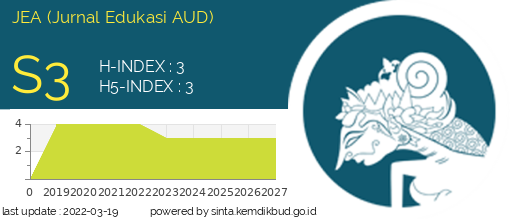
Accreditation
All manuscripts submitted to JEA (Jurnal Edukasi AUD) are processed through editorial screening and peer review to ensure originality, quality, relevance, and academic contribution.
JEA applies a peer-review process to evaluate the scientific quality of submitted manuscripts. The review process is conducted objectively, confidentially, and based on the journal’s focus and scope.
After submission, the editorial team checks the manuscript to ensure that it meets the basic requirements of the journal.
The initial screening includes:
Manuscript suitability with the focus and scope of JEA.
Compliance with the author guidelines and article template.
Completeness of manuscript structure.
Similarity check.
Reference quality and citation style.
Relevance of the topic to early childhood education studies.
Manuscripts that do not meet the basic requirements may be returned to the author for revision or rejected before peer review.
All submitted manuscripts are checked for similarity using Turnitin or other plagiarism detection tools.
The maximum similarity tolerance is 20%, excluding references and direct quotations. Manuscripts with a similarity score above the journal tolerance may be returned to the author for revision or rejected, depending on the level and nature of similarity.
Manuscripts that pass the initial editorial screening are sent to reviewers.
Each manuscript is reviewed by at least two reviewers who have expertise relevant to the topic of the manuscript. The review process is conducted using a blind review system to maintain objectivity and academic integrity.
Reviewers evaluate the manuscript based on:
Originality and novelty.
Relevance to the journal focus and scope.
Clarity of research objectives.
Appropriateness of research method.
Quality of data analysis.
Depth of results and discussion.
Use of relevant and current references.
Contribution to early childhood education studies.
Compliance with publication ethics.
Each manuscript that passes the initial editorial screening will be reviewed by at least two reviewers with relevant expertise.
Reviewers are expected to provide objective, constructive, and timely evaluations. Reviewers must maintain the confidentiality of the manuscript and must not use the manuscript for personal interest.
Reviewers must declare any conflict of interest. If a reviewer feels unqualified to review the manuscript or cannot complete the review within the required time, the reviewer should inform the editor.
The review process normally takes 2 to 4 weeks after the manuscript is assigned to reviewers. The duration may vary depending on reviewer availability, revision quality, and editorial considerations.
The editor makes the final decision based on reviewer comments, journal policy, manuscript quality, and relevance to the journal.
The editorial decision may include:
Accepted.
Accepted with minor revision.
Major revision required.
Rejected.
If revision is required, the author must revise the manuscript based on the reviewer and editor comments. The revised manuscript may be reviewed again when necessary.
If the reviewers provide substantially different recommendations, the editor may assign an additional reviewer or make a decision based on the strength of the review reports, journal policy, and manuscript quality.
Authors must submit the revised manuscript within the time specified by the editor.
The revised manuscript should be accompanied by a clear response to reviewer comments. Authors should explain how each comment has been addressed. If authors disagree with a reviewer's comment, they should provide a clear academic explanation.
The final decision on manuscript acceptance is made by the Editor in Chief or the assigned editor. The decision is based on reviewer recommendations, revision quality, originality, ethical compliance, and the journal’s publication standards.
All manuscripts submitted to JEA are treated as confidential documents. Editors and reviewers must not disclose information about submitted manuscripts to anyone outside the editorial and review process.
Editors and reviewers must avoid handling manuscripts when there is a conflict of interest involving the authors, institutions, research topic, funding, or other relevant matters.
If a conflict of interest is identified, the manuscript will be assigned to another editor or reviewer.
The peer review process follows the journal’s publication ethics. Any indication of plagiarism, duplicate submission, data fabrication, authorship dispute, or ethical violation will be handled according to the journal’s publication ethics, plagiarism policy, and retraction and correction policy.
JEA (Jurnal Edukasi AUD)

JEA (Jurnal Edukasi AUD) is licensed under a Creative Commons Attribution 4.0 International License.