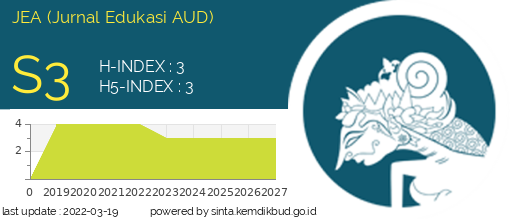
Accreditation
JEA (Jurnal Edukasi AUD) is committed to maintaining high standards of publication ethics and academic integrity. This policy applies to all parties involved in the publication process, including authors, editors, reviewers, and publishers.
Publication ethics in JEA are intended to ensure originality, transparency, accountability, fairness, and integrity in scholarly publishing.
Editors are responsible for managing the editorial and publication process fairly, objectively, and professionally.
Editors evaluate manuscripts based on academic quality, originality, relevance to the journal focus and scope, methodological clarity, contribution to early childhood education studies, and compliance with publication ethics.
Editors must not discriminate against authors based on gender, religion, ethnicity, nationality, institutional affiliation, political belief, or other personal backgrounds.
Editors must maintain the confidentiality of submitted manuscripts. Information about submitted manuscripts may only be shared with the corresponding author, reviewers, editorial team, and publisher when necessary.
Editors must avoid conflicts of interest. If an editor has a conflict of interest with a manuscript, the manuscript should be handled by another editor.
Editors are responsible for making publication decisions based on reviewer comments, editorial assessment, journal policy, and academic standards.
Reviewers assist editors in making editorial decisions and help authors improve the quality of their manuscripts.
Reviewers must evaluate manuscripts objectively, constructively, and confidentially. Personal criticism of authors is not allowed.
Reviewers should assess the originality, relevance, method, analysis, results, discussion, references, ethical issues, and contribution of the manuscript.
Reviewers must declare any conflict of interest before accepting a review assignment.
Reviewers must not share, copy, distribute, cite, or use unpublished manuscript materials for personal purposes.
If reviewers find plagiarism, duplicate publication, data fabrication, ethical problems, or substantial similarity with other works, they must inform the editor.
Authors must submit original work that has not been published elsewhere and is not under consideration by another journal or publisher.
Authors are responsible for the accuracy, originality, and integrity of the submitted manuscript.
Authors must properly cite all sources used in the manuscript. Plagiarism, self-plagiarism, data fabrication, data falsification, duplicate submission, and inappropriate authorship are not acceptable.
Authors must ensure that all listed authors have made a significant contribution to the manuscript. All authors must approve the final version of the manuscript before submission.
Authors must disclose any conflict of interest related to the research, funding, institution, or publication process.
Authors must state funding information when relevant. If the research received no external funding, authors should state it clearly.
For research involving children, teachers, parents, schools, or early childhood education institutions, authors must explain ethical considerations, permission, consent, or other relevant procedures.
Authorship should be limited to individuals who have made significant contributions to the conception, design, data collection, analysis, interpretation, writing, or revision of the manuscript.
Individuals who contributed to the research but do not meet authorship criteria may be acknowledged in the manuscript.
The corresponding author is responsible for ensuring that all authors agree to the submission and publication of the manuscript.
JEA does not tolerate plagiarism in any form.
All submitted manuscripts are screened using Turnitin or other plagiarism detection tools. The maximum similarity tolerance is 20%, excluding references and direct quotations.
Manuscripts with similarity above the journal tolerance may be returned to the author for revision or rejected, depending on the level and nature of similarity.
Authors must not submit the same manuscript to more than one journal at the same time.
Authors must not publish the same research in more than one journal or publication outlet without proper justification and citation.
Duplicate submission and redundant publication are considered unethical publishing practices.
Authors must present data accurately and honestly.
Data fabrication, data falsification, selective reporting, and manipulation of research findings are not acceptable.
Editors may request clarification, supporting data, or additional information from authors when necessary.
Authors, editors, and reviewers must disclose any conflict of interest that may influence the manuscript evaluation or publication process.
Conflicts of interest may include financial, institutional, personal, academic, collaborative, or competitive relationships.
If a conflict of interest is identified, the editorial team will take appropriate steps to maintain fairness and integrity.
Research involving human participants, especially children, parents, teachers, or educational institutions, must follow ethical research principles.
Authors should explain how permission, consent, confidentiality, and participant protection were handled in the study.
Research involving children must consider child protection, privacy, and the rights of participants.
Authors may submit complaints or appeals related to editorial decisions, review process, or publication ethics issues.
Complaints and appeals should be submitted to the editorial team through the official journal contact.
The editorial team will review complaints and appeals fairly, carefully, and based on journal policy.
JEA is committed to maintaining the integrity of the academic record.
Corrections may be issued when an article contains errors that do not invalidate the overall findings.
Retraction may be applied when an article contains serious errors, plagiarism, duplicate publication, unethical research, unreliable findings, or other serious academic misconduct.
Withdrawal may be considered before publication based on the author’s formal request and editorial approval.
Authors must use artificial intelligence tools responsibly.
Artificial intelligence tools must not be listed as authors. Authors remain fully responsible for the accuracy, originality, integrity, and ethical compliance of the manuscript.
If artificial intelligence tools are used in writing assistance, language editing, or data processing, authors should disclose their use when relevant.
The publisher supports the editorial team in maintaining the quality, integrity, visibility, and sustainability of the journal.
The publisher does not interfere with editorial decisions and supports the implementation of publication ethics, peer review, open access, archiving, and correction or retraction procedures.
Any indication of ethical misconduct will be reviewed by the editorial team.
The editorial team may request clarification from authors, reviewers, or related parties. Decisions may include manuscript rejection, revision request, correction, retraction, or notification to relevant institutions when necessary.
JEA handles ethical issues based on fairness, evidence, confidentiality, and academic integrity.
All parties involved in the publication process must support ethical scholarly publishing. Authors, editors, reviewers, and publishers are expected to act honestly, transparently, responsibly, and professionally.
JEA (Jurnal Edukasi AUD)

JEA (Jurnal Edukasi AUD) is licensed under a Creative Commons Attribution 4.0 International License.