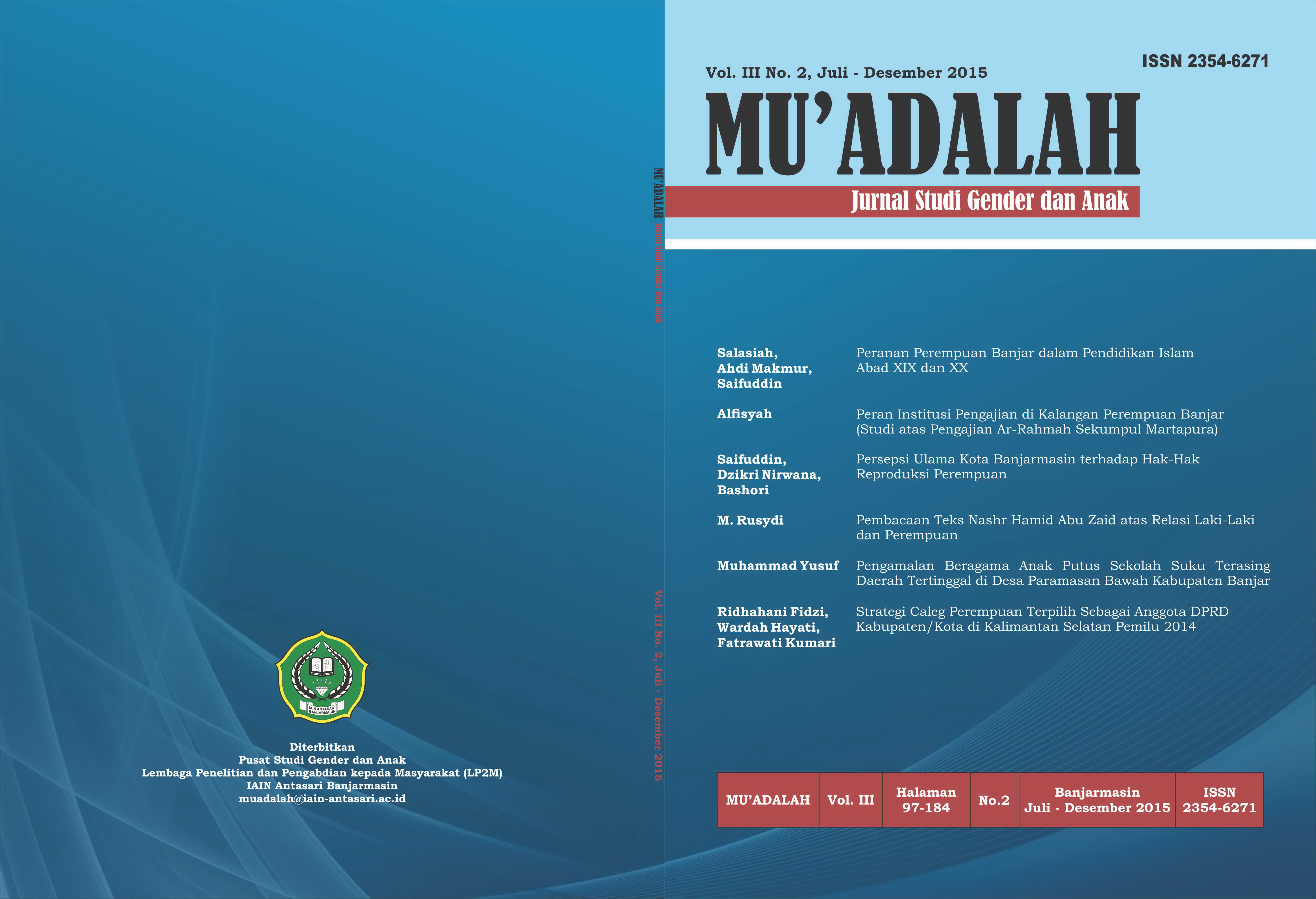
Strategi Caleg Perempuan Terpilih Sebagai Anggota DPRD Kabupaten/Kota Di Kalimantan Selatan Pemilu 2014
DOI:
https://doi.org/10.18592/jsga.v3i2.652Keywords:
Women Legislature Candidates, Political Marketing Strategy, Social Capital StrategyAbstract
Women’s right in politics has been regulated by law. Specifically, Law No. 12 of 2003, article 65, paragraph 1, has specified the quota of women in the general election by 30 percent. Nevertheless, the women’s representation in the legislative has not met expectations. The data from the Ministry of Women Empowerment and Child Protection has shown that the number of women who sit in the House of Representatives (DPR) is only 18 percent, while in the People’s Consultative Assembly (MPR) and the Regional Representative Council
(DPD) are respectively 20 and 27 percent,. The data also shows that the women who sit in the Province Legislative Council (DPRD Provinsi) is only 16 percent, and 12 percent in the City Council (DPRD Kota) dan the Regency (DPRD Kabupaten). The success of the women candidates to become the members of legislature can not be separated from their sincerity and persistence efforts to apply the right strategy. Strategies determine the success of the candidates. Referring to the importance of strategy, thus, it becomes significant to
specifically examine the candidates’ strategies in a study entitled: “Strategi Caleg Perempuan Terpilih sebagai Anggota DPRD Kabupaten/Kota di Kalimantan Selatan Pemilu 2014” The problem formulated in this study is how the strategies implemented by the elected women candidates as the members of the City Council and the Regency in South Kalimantan in the 2014 Election. The study employs qualitative method through descriptive study. The study takes place in South Kalimantan where the samples are taken from seven locations with a diverse number of votes. There are three findings from the study. First, in general, the elected women candidates have employed the strategy of political marketing and the strategy of social capital. The strategy of political marketing employed by the elected candidates include: segmentation and mapping, campaign and positioning, and evaluation and monitoring. Second, the
socialization is held privately by door-to-door visiting the people. The candidates carry out periodic evaluation and monitoring with involving their successful team. Third, the entire candidate has a good social capital, i.e. the ability to relate and cooperate with others. The social capital includes: the ability to build network and to gain thrust, and to bind themselves to the religious beliefs of the candidates and the public in their electoral district
Downloads
Published
How to Cite
Issue
Section
License
Authors who publish with this journal agree to the following terms:
- Authors retain copyright and grant the journal right of first publication with the work simultaneously licensed under a Creative Commons Attribution License that allows others to share the work with an acknowledgement of the work's authorship and initial publication in this journal.
- Authors are able to enter into separate, additional contractual arrangements for the non-exclusive distribution of the journal's published version of the work (e.g., post it to an institutional repository or publish it in a book), with an acknowledgement of its initial publication in this journal.
- Authors are permitted and encouraged to post their work online (e.g., in institutional repositories or on their website) prior to and during the submission process, as it can lead to productive exchanges, as well as earlier and greater citation of published work.