Reconstructing Inland Islamization: A Mosque-Centric and Tradition-Integrated Model from Banua Lima, South Kalimantan
DOI:
https://doi.org/10.18592/albanjari.v24i2.8567Keywords:
Values, Islamic, Education, Traditions of Bapalas bidan.Abstract
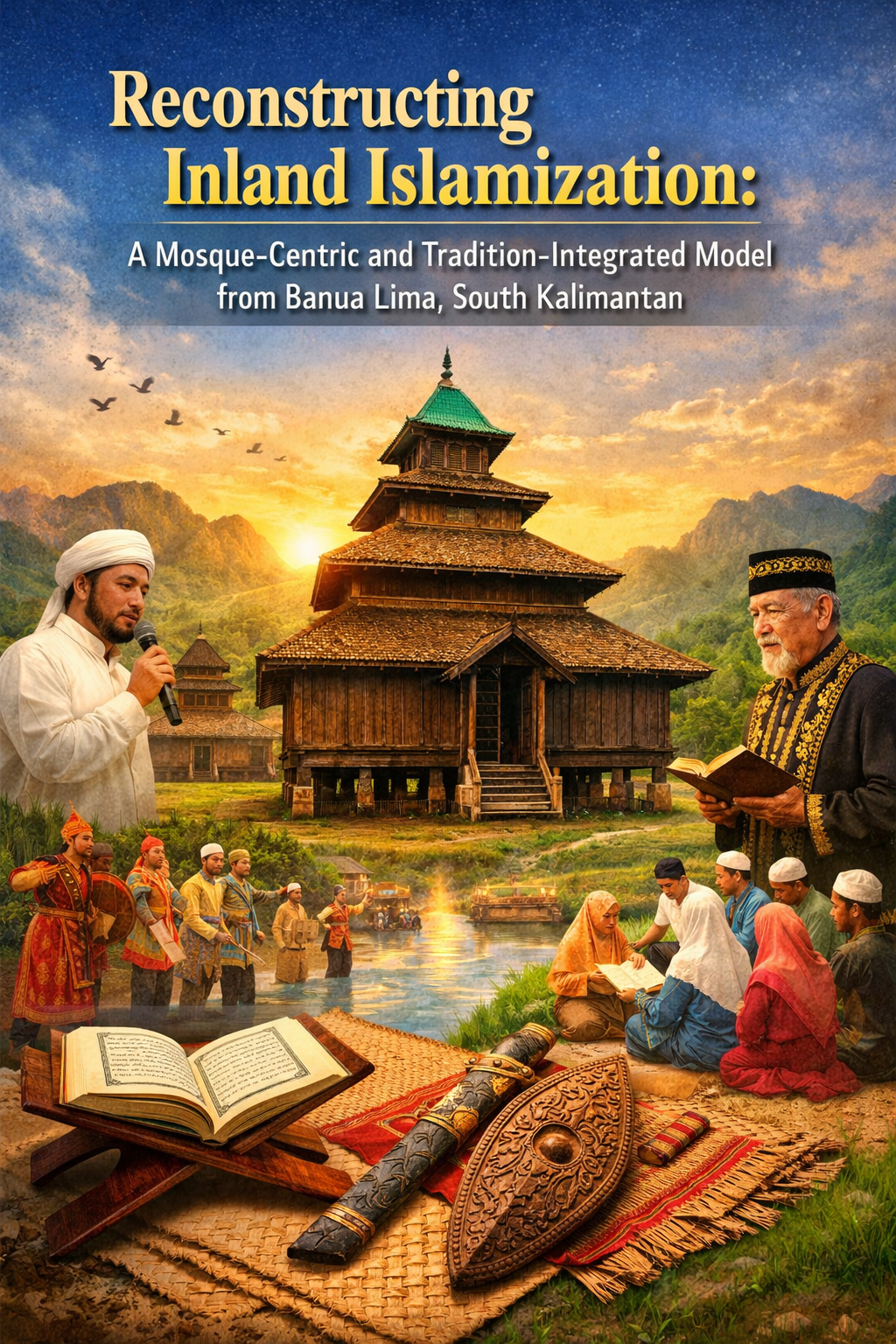
The history of Islamic dissemination in Banua Lima particularly along the Batang Alai River Basin in Barabai remains poorly documented, resulting in a fragmented understanding of early Islamization in the upstream region compared to the more extensively recorded coastal areas. This study aims to reconstruct the development pattern of Islam in Banua Lima by examining historical traces, the role of sacred mosques, local religious figures, and the acculturation of pre-Islamic traditions. Employing a historical-social approach with heuristic, verification, interpretation, and historiographical stages, data were collected through archival studies, oral histories, site observation of heritage mosques, and documentation of cultural rituals. The findings indicate that Islam spread through three fundamental mechanisms: the establishment of mosques as centers of religious activities, the empowerment of local figures as key agents of da'wah, and the integration of indigenous traditions such as Baayun Maulid and Batumbang—into Islamic practice. Heritage mosques in Palajau, Banua Halat, Banua Lawas, and surrounding areas serve as material evidence of the da'wah mission led by Khatib Dayan. The study concludes that the Islamization process in Banua Lima was peaceful, adaptive, and collaborative, forming a da'wah model that remains contextually relevant for contemporary local communities. Further research and preservation of historical mosques and cultural traditions are recommended as strategic efforts to maintain the Islamic historical legacy in South Kalimantan.
References
Buseri, Kamrani. 2009. Sepintas Masuknya Islam Di Borneo, artikel.
Hasanbanjary. 2016. Islam dan Budaya Banjar di Kalimantan Selatan https://www.hasanbanjary.com/2016/06/islam-dan-budaya-banjar-di-kalimantan.html?m=0, diakses pada tanggal 8 November 2022.
Hendraswati, Wajidi, Tajuddin Noor Ganie, Syarifuddin R, Agus Wibowo, UPACARA DAUR HIDUP MASYARAKAT SUKU BANJAR DI KALIMANTAN SELATAN, ed. by Zulfa Jamalie, 2nd edn (Pontianak: BALAI PELESTARIAN NILAI BUDAYA PONTIANAK, 2022)
Jamalie, Zulfa, ‘Akulturasi Dan Kearifan Lokal Dalam Tradisi Baayun Maulid Pada Masyarakat Banjar’, El-HARAKAH (TERAKREDITASI), 16.2 (2014), 234 <https://doi.org/10.18860/el.v16i2.2778>
Jannah, R, ‘Budaya Baayun Maulid Masyarakat Banjar: Interaksi Sosial Untuk Nilai Kerohanian’, Bihari: Jurnal Pendidikan Sejarah Dan Ilmu …, 4.2 (2021), 90–108
M. Suriansyah Ideham, Hj. Jurliani Djohansjah, H. Djantera Kawi, Urang Banjar Dan Kebudayaan, ed. by Wajidi M. Suriansyah Ideham, H. Sjarifuddin, M. Zainal Arifin Anis, Cetakan Pe (Banjarmasin: PT. Grafika Wangi Kalimantan, 2005)
Maimanah, Norhidayat, ‘TRADISI BAAYUN MULUD DI BANJARMASIN’, 11.1 (2012), 51–76
Salim, Agus, dkk 2021. Khazanah Keislaman Masyarakat Banjar, Penerbit Samudra Biru (Anggota IKAPI)
Wajidi, Akulturasi Budaya Banjar DI BANUA HALAT, Cet. 2 (Yogyakarta: Penerbit Pustaka Book Publisher, 2022) <https://www.ptonline.com/articles/how-to-get-better-mfi-results>
———, ‘HUBUNGAN ISLAM DAN BUDAYA DALAM TRADISI BA-AYUN MAULID DI MASJID BANUA HALAT KABUPATEN TAPIN, KALIMANTAN SELATAN’, 6.2 (2014), 349–66
Downloads
Published
Issue
Section
License
Copyright (c) 2025 Al-Banjari : Jurnal Ilmiah Ilmu-Ilmu Keislaman

This work is licensed under a Creative Commons Attribution-ShareAlike 4.0 International License.
Authors who publish with this journal agree to the following terms:
- Authors retain copyright and grant the journal right of first publication with the work simultaneously licensed under a Creative Commons Attribution License that allows others to share the work with an acknowledgement of the work's authorship and initial publication in this journal.
- Authors are able to enter into separate, additional contractual arrangements for the non-exclusive distribution of the journal's published version of the work (e.g., post it to an institutional repository or publish it in a book), with an acknowledgement of its initial publication in this journal.
- Authors are permitted and encouraged to post their work online (e.g., in institutional repositories or on their website) prior to and during the submission process, as it can lead to productive exchanges, as well as earlier and greater citation of published work (See The Effect of Open Access).






 This work is licensed under a