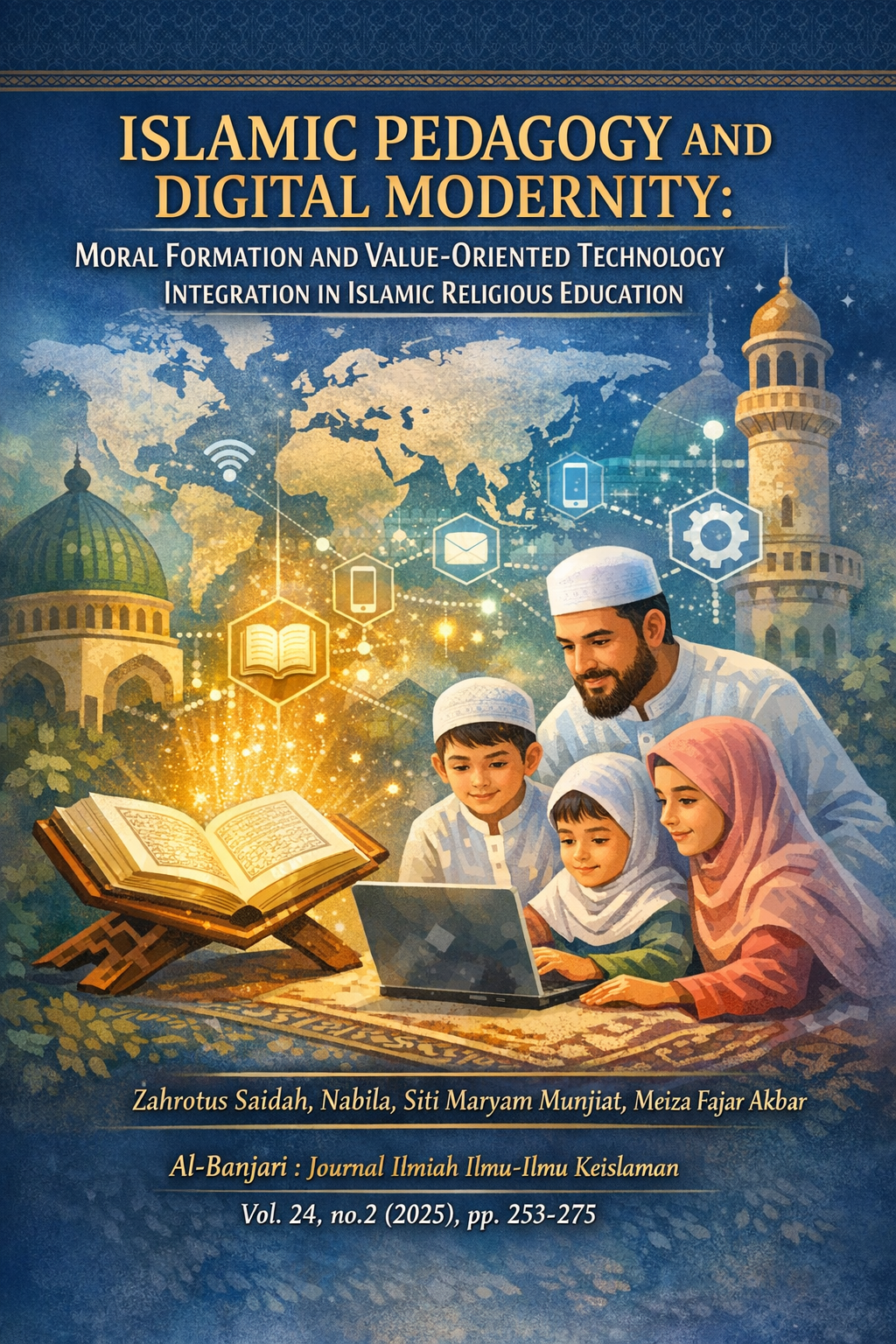
Islamic Pedagogy and Digital Modernity: Moral Formation and Value-Oriented Technology Integration in Islamic Religious Education
DOI:
https://doi.org/10.18592/albanjari.v24i2.18591Abstract
The rapid digitalization of education has transformed Islamic Religious Education (PAI) while simultaneously generating significant pedagogical and normative challenges, particularly in sustaining Islamic pedagogy and moral–spiritual formation within digital learning environments. When digital media integration is not guided by value-oriented pedagogy, PAI risks becoming technocratic and instrumental, undermining its core mission of cultivating akhlaq karimah, religious consciousness, and ethical agency among learners. This study aims to analyze and formulate a digital media integration model for PAI learning in Cirebon that is pedagogically transformative and normatively grounded in Islamic educational values. Using a mixed methods approach with a sequential explanatory design, quantitative data were collected through a survey of 30 PAI teachers in schools and madrasahs in the Cirebon region, followed by qualitative data from open-ended interviews. Data were analysed using descriptive statistics and the Miles and Huberman qualitative model, drawing on TPACK theory, the SAMR model, and an Islamic pedagogy framework emphasizing the integration of ‘ilm, iman, and ‘amal salih. The findings indicate that digital integration in PAI remains largely at substitution and augmentation levels, yet reflective, contextual, and collaborative digital practices significantly enhance student engagement and moral internalization. The study concludes that effective digital integration in PAI requires a value-conscious Islamic pedagogical framework supported by institutional policy and continuous professional development.
Downloads
Published
Issue
Section
License
Copyright (c) 2025 Zahrotus Saidah, Nabila Nabila, Siti Maryam Munjiat, Meiza Fajar Akbar

This work is licensed under a Creative Commons Attribution-ShareAlike 4.0 International License.
Authors who publish with this journal agree to the following terms:
- Authors retain copyright and grant the journal right of first publication with the work simultaneously licensed under a Creative Commons Attribution License that allows others to share the work with an acknowledgement of the work's authorship and initial publication in this journal.
- Authors are able to enter into separate, additional contractual arrangements for the non-exclusive distribution of the journal's published version of the work (e.g., post it to an institutional repository or publish it in a book), with an acknowledgement of its initial publication in this journal.
- Authors are permitted and encouraged to post their work online (e.g., in institutional repositories or on their website) prior to and during the submission process, as it can lead to productive exchanges, as well as earlier and greater citation of published work (See The Effect of Open Access).






 This work is licensed under a