ASyA Theories ( Adaptive Sharia Advantage): An Interdisciplinary Study of Maqasid al-Shariah and the MILES Concept in Reformulating the Resilience of Muslim Communities
DOI:
https://doi.org/10.18592/albanjari.v24i2.17960Abstract
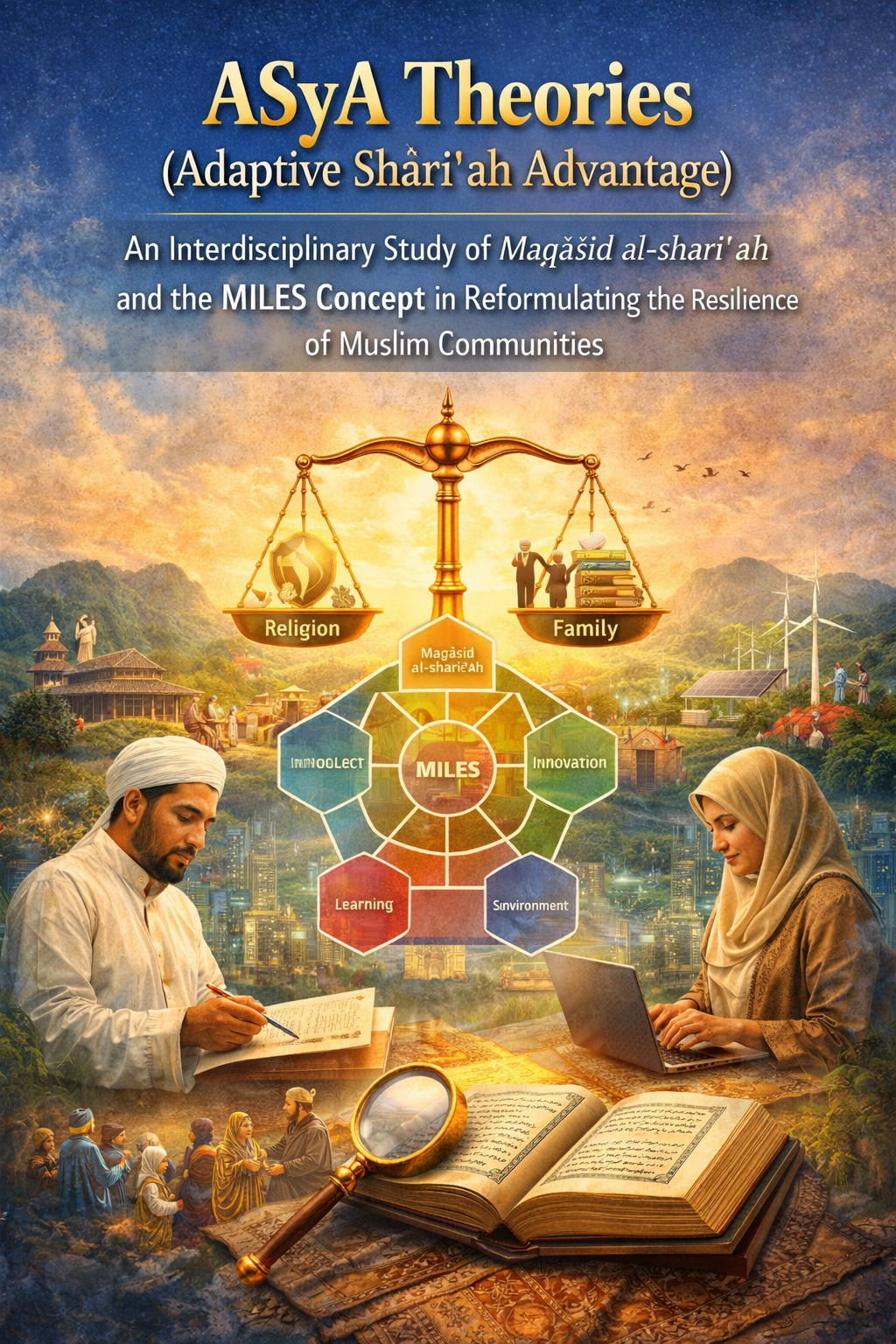
Contemporary Muslim societies are increasingly shaped by a pattern of ritual-centered religiosity that emphasizes symbolic devotion while neglecting the substantive objectives of Islamic law (maqasid al-shariah). This trend has generated a fragile form of social resilience, marked by weakened critical literacy, poor economic planning, deteriorating family communication, and heightened vulnerability to psychological and social pressures. This condition reflects an urgent crisis of meaning, in which religious enthusiasm is no longer balanced by strategic rationality and ethical responsibility. Classical Islamic scholarship, as represented by Al-Ghazali, Al-Shatibi, and Ibn al-Qayyim, positions maqasid al-shariah as the core of Islamic law, oriented toward the preservation of religion, life, intellect, wealth, and lineage. However, in contemporary contexts, this normative framework often remains abstract and detached from practical social realities, resulting in a persistent gap between theory and lived experience.
This study aims to formulate the ASyA Theory (Adaptive Shariah Advantage) as an integrative model that reconnects maqasid al-shariah with the practical dimensions of modern life through the MILES framework (Money, Intelligence, Location, Education, Status). The research employs an original qualitative approach termed the Maqasid–MILES Adaptive Synthesis Method (MMAS), which consists of three stages: (1) textual deconstruction of classical maqasid literature, (2) logical fallacy mapping of contemporary religious discourse, and (3) critical adaptive synthesis linking maqasid domains with MILES components. The study produces an interdisciplinary conceptual matrix in which each element of MILES is systematically mapped onto the five essential protections of maqasid al-shariah.
This integration offers a dynamic and contextualized model capable of strengthening religious integrity, economic resilience, intellectual maturity, environmental awareness, and intergenerational continuity within Muslim communities. The ASyA Theory thus presents a transformative approach that shifts maqasid from a purely normative framework into an operational strategy for social resilience. It is proposed as a foundational model for future empirical research, educational reform, and policy-oriented Islamic social development.
Downloads
Published
Issue
Section
License
Copyright (c) 2025 M Yakhsyallah Liddinillah

This work is licensed under a Creative Commons Attribution-ShareAlike 4.0 International License.
Authors who publish with this journal agree to the following terms:
- Authors retain copyright and grant the journal right of first publication with the work simultaneously licensed under a Creative Commons Attribution License that allows others to share the work with an acknowledgement of the work's authorship and initial publication in this journal.
- Authors are able to enter into separate, additional contractual arrangements for the non-exclusive distribution of the journal's published version of the work (e.g., post it to an institutional repository or publish it in a book), with an acknowledgement of its initial publication in this journal.
- Authors are permitted and encouraged to post their work online (e.g., in institutional repositories or on their website) prior to and during the submission process, as it can lead to productive exchanges, as well as earlier and greater citation of published work (See The Effect of Open Access).






 This work is licensed under a