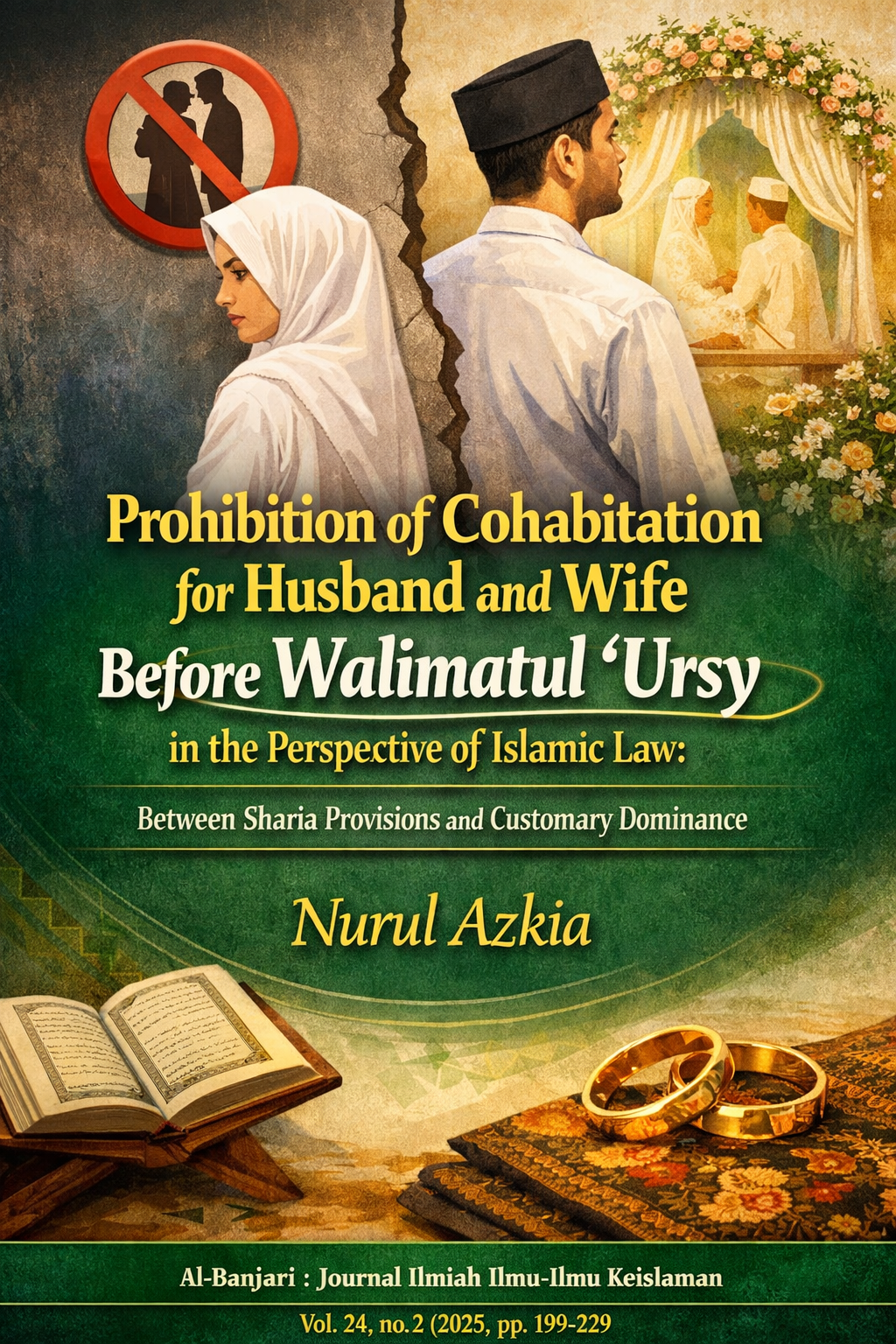
Prohibition of Cohabitation for Husband and Wife Before Walimatul ‘ursy in the Perspective of Islamic Law: Between Sharia Provisions and Customary Dominance
DOI:
https://doi.org/10.18592/albanjari.v24i2.17876Abstract
The practice of prohibiting married couples from living together after the marriage contract but before the walÄ«mat al-‘ursy (commonly known as nikah gantung) remains socially binding in Hamayung Village, Hulu Sungai Selatan. This practice has generated controversy because it delays the exercise of spousal rights and obligations that, under Islamic law, should take effect immediately upon the conclusion of the marriage contract. As such, nikah gantung reflects a tension between the legal certainty of Islamic law and the dominance of customary norms as living law. This study aims to assess the compatibility of nikah gantung with Islamic legal principles through the frameworks of ‘urf and maqÄá¹£id al-sharī‘ah. The research adopts a normative Islamic legal (juridical-fiqhiyyah) method combined with a socio-legal approach, drawing on classical and contemporary fiqh literature, usul al-fiqh sources, statutory regulations, and limited field data to contextualize the practice. Data are analyzed qualitatively through takyÄ«f fiqhÄ«, evaluation of ‘urf, and maqÄá¹£id-based assessment. The findings indicate that postponement of post-contractual rights may be permissible when it is voluntary and grounded in legitimate shar‘i excuses; however, the practice in Hamayung Village is collective, coercive, and reinforced by social sanctions, effectively transforming the recommended walÄ«mat al-‘ursy into a de facto legal condition. Consequently, this practice cannot be classified as ‘urf á¹£aḥīḥ and contradicts legal certainty and family welfare. The study recommends strengthening legal awareness and repositioning customary norms to align with the objectives of Islamic law.
Downloads
Published
Issue
Section
License
Copyright (c) 2025 Nurul Azkia

This work is licensed under a Creative Commons Attribution-ShareAlike 4.0 International License.
Authors who publish with this journal agree to the following terms:
- Authors retain copyright and grant the journal right of first publication with the work simultaneously licensed under a Creative Commons Attribution License that allows others to share the work with an acknowledgement of the work's authorship and initial publication in this journal.
- Authors are able to enter into separate, additional contractual arrangements for the non-exclusive distribution of the journal's published version of the work (e.g., post it to an institutional repository or publish it in a book), with an acknowledgement of its initial publication in this journal.
- Authors are permitted and encouraged to post their work online (e.g., in institutional repositories or on their website) prior to and during the submission process, as it can lead to productive exchanges, as well as earlier and greater citation of published work (See The Effect of Open Access).