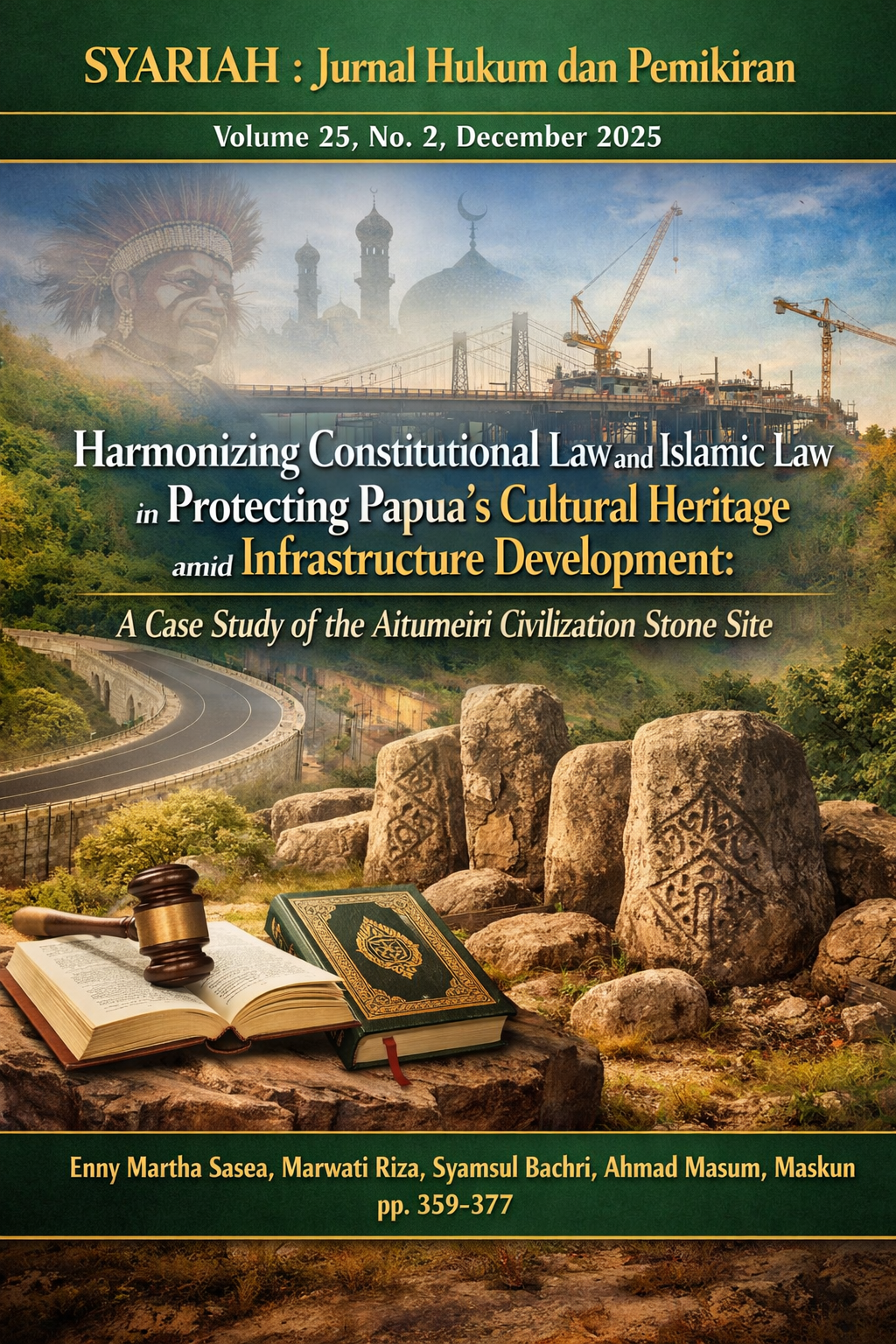
Harmonizing Constitutional Law and Islamic Law in Protecting Papua’s Cultural Heritage amid Infrastructure Development: A Case Study of the Aitumeiri Civilization Stone Site
DOI:
https://doi.org/10.18592/sjhp.v25i2.18090Abstract
Rapid infrastructure development in Papua has intensified tension between economic growth and the protection of indigenous cultural heritage. This condition represents a critical phenomenon marked by regulatory change and the urgent need for sustainable legal solutions in culturally sensitive regions. Existing legal frameworks often operate in a fragmented manner, weakening effective heritage protection. The theoretical framework of this study lies at the intersection of constitutional law, Islamic law, and legal pluralism. Although the Indonesian Constitution guarantees cultural advancement and the recognition of indigenous rights, and Islamic law provides ethical guidance through maqÄá¹£id al-sharÄ«Ê¿ah, their integration in heritage governance remains limited. This study aims to examine the harmonization of constitutional law and Islamic law in protecting Papua’s cultural heritage, using the Aitumeiri Civilization Stone Site as a case study. The research employs a normative legal method with statutory and conceptual approaches, supported by qualitative analysis and a maqÄá¹£id al-sharÄ«Ê¿ah framework focusing on the protection of religion, intellect, and lineage. The findings reveal overlapping regulations, weak intergovernmental coordination, and limited indigenous participation as major obstacles to effective heritage governance. Integrating maqÄá¹£id al-sharÄ«Ê¿ah into constitutional interpretation strengthens normative coherence and moral legitimacy. In conclusion, harmonized and inclusive legal frameworks are essential to safeguard Papua’s cultural heritage within sustainable development. The study recommends strengthening maqÄá¹£id-based regional regulations, institutionalizing consultative mechanisms inspired by shÅ«rÄ, and mandating heritage impact assessments involving indigenous communities.
References
Ali, Tahir, Petra Topaz Buergelt, Douglas Paton, James Arnold Smith, Elaine Lawurrpa Maypilama, Dorothy Yuŋgirrŋa, Stephen Dhamarrandji, Stephen Dhamarrandji, dan Rosemary Gundjarranbuy. “Facilitating Sustainable Disaster Risk Reduction in Indigenous Communities: Reviving Indigenous Worldviews, Knowledge and Practices through Two-Way Partnering.†International J. Environ. Res. Public Health 18, no. 3 (2021): 1–28. https://doi.org/https://doi.org/10.3390/ijerph18030855.
Andi Sugirman, et al. State and Protection of Cultural Heritage in Bone, South Sulawesi: Perspective of National Law and Islamic Law. Samarah: Jurnal Hukum Keluarga dan Hukum IslamVolume 8.No. 3.November 2024 ISSN: 2549 –3132; E-ISSN: 2549 –3167DOI: 10.22373/sjhk.v8i3.22125
An-Naim, Abdullahi Ahmed. Islam and the Secular State. Cambridge: Harvard University Press, 2010.
Appadurai, Arjun. Modernity At Large: Cultural Dimensions of Globalization. Minneapolis: University of Minnesota Press, 1996.
Armadhany, Vita Fatimah, dan Anjar Sri Ciptorukmi. “The Protection For Traditional Cultural Expression In Indonesian Constitution And National Law System.†International Journal of Business, Economics and Law 26, no. 2 (2022): 44–47.
Aspinall, Edward, dan Mark T. Berger. “The Break-up of Indonesia? Nationalisms after Decolonisation and the Limits of the Nation-State in Post-Cold War Southeast Asia.†Third World Quarterly 22, no. 6 (2001): 1003–24.
Auda, Jasser. Maqasid Al-shariah as Philosophy of Islamic Law: A Systems Approach. London: The International Institute of Islamic Thought, 2008.
Bukido, Rosdalina, Nurlaila Harun, Edi Gunawan, dan Rahman Mantu. “Harmonization of customary and Islamic law in the gama tradition of the muslim Mongondow community of North Sulawesi.†IJTIHAD Jurnal Wacana Hukum Islam dan Kemanusiaan 22, no. 2 (2022): 239–54. https://doi.org/10.18326/ijtihad.v22i2.239-254.
Craith, Mairead Nic, Michele Langfield, dan William Logan. Cultural Diversity, Heritage and Human Rights: Intersections in Theory and Practice. Routledge, 2010.
Fatem, Sepus M. “Connecting social forestry to conservation policies in Tanah Papua.†Forest and Society 3, no. 1 (2019): 141–47. https://doi.org/10.24259/fs.v3i1.5865.
Haryati, Sri. “Papua, West Papua welcome revised special autonomy law.†ANTARA, 2021.
Hasan, Baidar Mohammed Mohammed, Hasnizam Hashim, Wan Abdul Fattah Wan Ismail, dan Mualimin Mochammad Sahid. “Islamic Constitutionalism and the Management of Diversity: The Dialectic of Coexistence and Empowerment -A Case Study of ‘Rukun Negara’ and ‘Pancasila.’†In International Conference on Islamic Economic (ICIE), 199–213, 2025.
Hooker, M Barry. Indonesian Syariah: Defining a National School of Islamic Law. Institute of Southeast Asian Studies, 2008.
Husain, Muhammad Zakir. 2025. “Religious Moderation and the Development of Multicultural Societies in Indonesia: A Normative-Islamic Legal Studyâ€. ASEAN Journal of Islamic Studies and Civilization (AJISC) 2 (1):27-60. https://doi.org/10.62976/ajisc.v2i1.1368.
Indonesia-Tourism.com. “Aitumeiri Hill.†Indonesia-Tourism.com, 2021.
Iuhukay, Roni Sulistyanto, Tatiek Sri Djatmiati, dan Emanuel Sujatmoko. “Reflecting the Special Autonomy of Papua Province in the Perspective of Law and Human Rights.†Jurisprudentie : Jurusan Ilmu Hukum Fakultas Syariah Dan Hukum 9, no. 2 (2022): 120–144. https://doi.org/https://doi.org/10.24252/jurisprudentie.v9i2.31843.
Irma Suryani et al. Integration of Islamic Law in Regional Development in Indonesia JURIS (Jurnal Ilmiah Syariah), 22(1), 1–11. 2023 https://doi.org/10.31958/juris.v22i1.8770
Kamali, Mohammad Hashim. “History and Jurisprudence of the MaqÄá¹£id.†American Journal of Islam and Society 38, no. 3 (2021): 8–34. https://doi.org/https://doi.org/10.35632/ajis.v38i3-4.3110.
———. “Maqasid al-Shariah, Ijtihad and Civilisational Renewal.†London, 2021.
Koentjaraningrat. Manusia dan Kebudayaan di Indonesia. Jakarta: Djambatan, 2009.
Labadi, Sophia, dan William Logan. Urban Heritage, Development and Sustainability: International Frameworks, National and Local Governance. Routledge, 2016.
Lewuk, Domi Dese. “KNPI Teluk Wondama Apresiasi Revitalisasi Situs Batu Peradaban Aitumieri.†Kabardaerah.com, 2024.
Lubis, Nur Ahmad Fadhil. “Islamic Legal Literature and Substantive Law in Indonesia.†Studia Islmanika 4, no. 4 (2014): 33–92. https://doi.org/10.15408/sdi.v4i4.765.
Maknuniah, J. ., Sutrisno , S. ., & Julianto, T. A. . (2025). Peacebuilding and Humanitarian Crises: The Role of Islamic Humanitarianism in Indonesia’s Conflict Resolution and Disaster Response. ASEAN Journal of Islamic Studies and Civilization (AJISC), 2(1), 117–133. https://doi.org/10.62976/ajisc.v2i1.1371
Matuankotta, Jenny Kristiana, dan Eric Stenly Holle. “State Recognition and Respect for the Rights of Customary Law Communities in the Maluku Islands Region in the Exploitation of Forest Resources.†SASI 28, no. 1 (2022): 107–23. https://doi.org/10.47268/sasi.v28i1.852.
McGibbon, Rodd. Secessionist Challenges in Aceh and Papua: Is Special Autonomy the Solution? Washington DC: East-West Center, 2004.
Mukhlis, Muh Mutawalli, Maskun, Muh Saleh Tajuddin, Zulhilmi Bin Paidi, dan Muh Mawardi Djalaluddin. “Challenges and Solutions in the Appointment of Acting Regional Heads (PJ. Kepala Daerah) in Indonesia: a Sharia and Islamic Democracy Perspective.†Justicia Islamica 22, no. 1 (2025): 115–34. https://doi.org/10.21154/justicia.v22i1.10688.
Mukhlis, Muhammad Mutawalli, Maskun, Muhammad Saleh Tajuddin, Jamal Aslan, Hariyanto, dan Hotlan Samosir. “Regional Autonomy System: Delegation of Authority and Power of Regional Government in Indonesia in the Study of Fiqh Siyasah.†Al-Istinbath Jurnal Hukum Islam 9, no. 2 (2024): 505–26.
Mukhlis, Muhammad Mutawalli, Harlida Abdul Wahab, Zulhilmi Paidi, Nila Sastrawaty, dan Haslinda Hasan. “Heavy Parliamentary v. Heavy Executive: Ambiguity of Power in Indonesian Constitutional Practices.†Jurnal Media Hukum 31, no. 2 (2024): 186–205. https://doi.org/https://doi.org/10.18196/jmh.v31i2.21703.
Mukhlis, Muhammad Mutawalli, Wamafma, Enny Martha Sasea, dan Enni Ekakusumawati. “Investment Law in Papua: Between Regulatory Certainty and Protection of Indigenous Peoples’ Rights.†PAMALI Pattimura Magister Law Review 5, no. 3 (2025): 574–84. https://doi.org/10.47268/pamali.v5i3.3453.
Pemerintah Daerah Kabupaten Teluk Wondana. “Situs Batu Peradaban Aitumeiri di Wondama Diresmikan, Ketua Sinode GKI Ajak Umat Hayati Kata-kata Pendeta I.S Kijne.†Pemerintah Daerah Kabupaten Teluk Wondana, 2024.
Qimyatussa’adah, dan Mala Sharma. “Indonesian Government Regulation on Heritage Registration.†Journal of Heritage Management 8, no. 1 (2023): 105–10. https://doi.org/https://doi.org/10.1177/24559296221147037.
Ramli. “’Urf As A Method Of Istinbath Islamic Law (Thought Of Hasbi As-Siddieqy With His Indonesian Fikih).†BIRCI Journal 5, no. 1 (2021): 5031–41.
Renn, Ortwin, Andreas Klinke, dan Marjolein van Asselt. “Coping with Complexity, Uncertainty and Ambiguity in Risk Governance: A Synthesis.†Ambio 40, no. 2 (2011): 231–246. https://doi.org/10.1007/s13280-010-0134-0.
Riandi, M. ., & Rusdiyah, R. (2025). The Interaction between Islam and Local Wisdom in Indonesia: A Normative-Philosophical Study. ASEAN Journal of Islamic Studies and Civilization (AJISC), 2(1), 93–115. https://doi.org/10.62976/ajisc.v2i1.1370
Rinaldi, Renold. “Calls mounted for completion of indigenous rights bill amidst discrepancy on basic terminology.†Indonesia Business Post, 2025.
Rodwell, Dennis. Conservation and Sustainability in Historic Cities. Oxford: Blackwell Publishing, 2007.
Sachs, Jeffrey D. The Age of Sustainable Development. Columbia University Press, 2015.
Sasea, Enny Martha. “Pengaturan Kewenangan Perlindungan dan Pelestarian Cagar Budaya di Tanah Papua.†Universitas Hasanuddin, 2025.
Sihotang, Amri Panahatan, Wafda Vivid Izziyana, dan Panji Wirawan. “Legal Protection of Indigenous Peoples and Traditional Communities in Indonesia from The Perspective of The Social Environment.†In Proceedings of the 1st International Conference on Social Environment Diversity (ICOSEND 2024), Advances in Social Science, 686–92. Atlantis Press SARL, 2025. https://doi.org/10.2991/978-2-38476-366-5_68.
Sokoy, Fredrik. “Economic Development of Indigenous Papuans: A Critical Analysis to Build Independent and Dignified Traditional Villages.†Journal of Social Science 3, no. 6 (2022): 1233–46. https://doi.org/10.46799/jss.v3i6.437.
Sumule, Agus Irianto, Ludia Wambrauw, Dwi Wasgito Purnomo, dan Yance de Fretes. “Culturally grounded pathways to sustainable agricultural investment in Papua.†Edelweiss Applied Science and Technology 9, no. 7 (2025): 1020–31. https://doi.org/10.55214/25768484.v9i7.8803.
Undang-undang (UU) Nomor 2 Tahun 2021 tentang Perubahan Kedua atas Undang-Undang Nomor 21 Tahun 2001 tentang Otonomi Khusus bagi Provinsi Papua (2021).
Undang-undang (UU) Nomor 21 Tahun 2001 tentang Otonomi Khusus Bagi Provinsi Papua (2001).
United Nations. “The Sustainable Development Goals Report 2023,†2023.
Wade, Robert H. “The World Development Report 2022: Finance for an Equitable Recovery in the Context of the International Debt Crisis.†Development and Change 54, no. 5 (2023): 1354–73. https://doi.org/https://doi.org/10.1111/dech.12796.
Waheeda, W., Mutakin, A. ., Isroiliyah, I., Lubis, R. ., & Saujan, I. . (2025). The Dynamic Interplay: A Normative-Philosophical Study of Islam and Local Wisdom in Indonesia. ASEAN Journal of Islamic Studies and Civilization (AJISC), 2(1), 61–91. https://doi.org/10.62976/ajisc.v2i1.1369
West Papua Daily. “Papuan history unveiled: Dutch missionaries’ influence on Papua’s education and culture.†West Papua Daily, 2023.
Downloads
Published
Issue
Section
License
Copyright (c) 2026 Enny Martha Sasea, Marwati Riza, Syamsul Bachri, Ahmad Masum

This work is licensed under a Creative Commons Attribution 4.0 International License.
Authors who publish with this journal agree to the following terms:
- Authors retain copyright and grant the journal right of first publication with the work simultaneously licensed under a Creative Commons Attribution License that allows others to share the work with an acknowledgement of the work's authorship and initial publication in this journal.
- Authors are able to enter into separate, additional contractual arrangements for the non-exclusive distribution of the journal's published version of the work (e.g., post it to an institutional repository or publish it in a book), with an acknowledgement of its initial publication in this journal.
- Authors are permitted and encouraged to post their work online (e.g., in institutional repositories or on their website) prior to and during the submission process, as it can lead to productive exchanges, as well as earlier and greater citation of published work.
Â