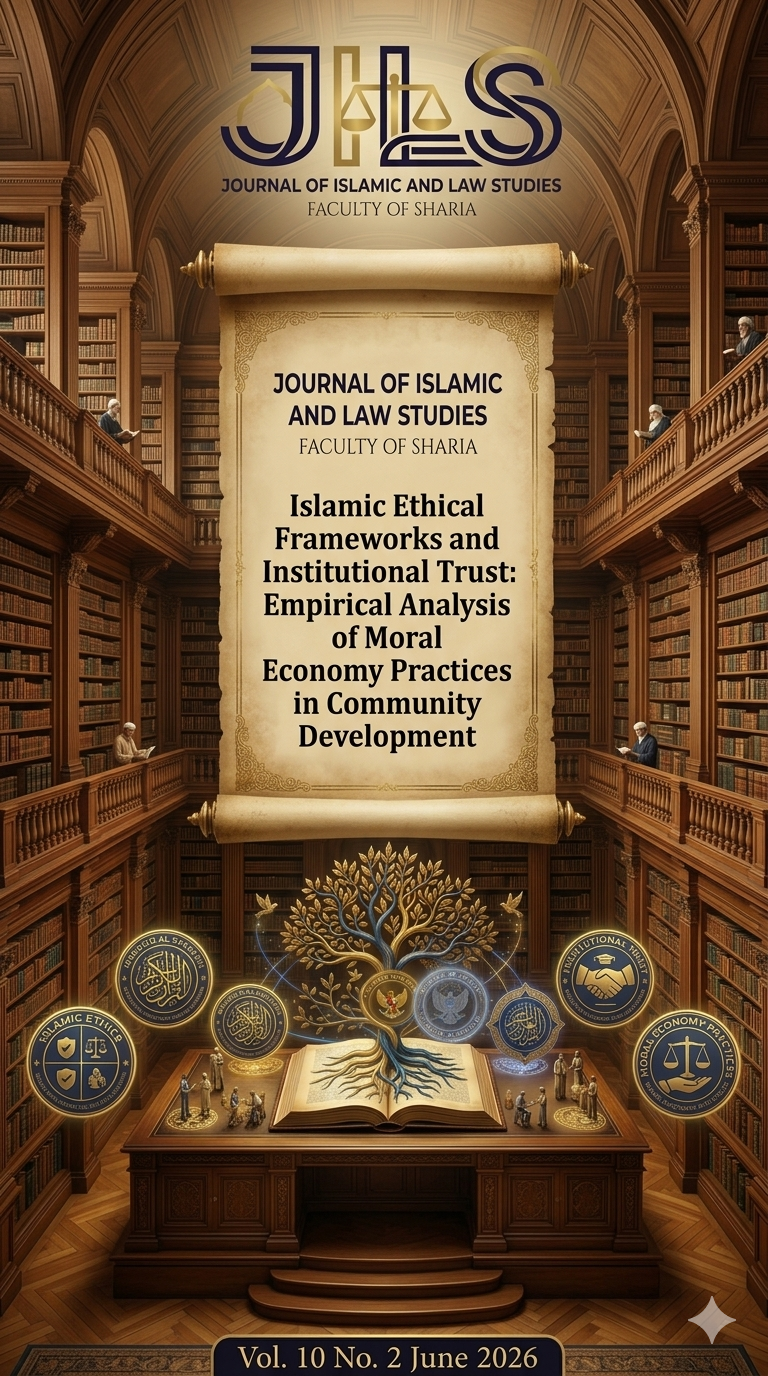
Islamic Ethical Frameworks and Institutional Trust: Empirical Analysis of Moral Economy Practices in Muslim Community Development
DOI:
https://doi.org/10.18592/jils.v10i1.20145Abstract
Contemporary Muslim societies face a critical gap between Islamic ethical principles and actual institutional practices in community development. This situation has intensified demand for values-driven financial and organizational systems that move beyond formal Shariah compliance to promote justice, sustainability, and social welfare. Recent institutional transformations indicate that Islamic organizations are increasingly embedding ethical frameworks into their operations, yet empirical validation is still needed to confirm whether explicit moral economy mechanisms can strengthen institutional trust. In this context, Maqasid al-Shariah offers a relevant framework for redesigning governance structures and social finance instruments.
Grounded in Maqasid al-Shariah, which prioritizes the protection of faith, life, intellect, lineage, and wealth, this study examines whether institutional trust in Muslim community development organizations increases when explicit Islamic ethical frameworks guide organizational practice. It also investigates how such frameworks are institutionalized, how moral economy practices relate to trust levels, and what mechanisms strengthen stakeholder confidence. This study employs a mixed-methods design combining qualitative case studies and quantitative survey analysis. Primary data were collected through 25 in-depth interviews with organizational leaders, Shariah scholars, and community members, along with focus group discussions in three Indonesian regions. Secondary data include organizational documents, financial reports, and governance records. Quantitative data from 320 community members were analyzed using structured questionnaires and exploratory factor analysis. The findings show that Islamic ethical frameworks significantly strengthen institutional trust when systematically embedded in organizational structures. Organizations integrating Maqasid al-Shariah principles recorded 45% higher trust scores than conventionally managed institutions. Transparent zakat management, participatory decision-making, and value-based intermediation also improved stakeholder engagement. In conclusion, Islamic ethical frameworks function effectively as trust-building mechanisms when institutionalized through explicit governance structures, making moral economy a viable alternative to purely market-driven approaches.
Downloads
Published
Issue
Section
License
Copyright (c) 2026 Nadiyah Nadiyah, Inawati Mohammad Jainie Jarajap, Diana Rahmi, Sa'adah Sa'adah, Farihatni Mulyati

This work is licensed under a Creative Commons Attribution-NonCommercial 4.0 International License.
Authors who publish with this journal agree to the following terms:
- Authors retain copyright and grant the journal right of first publication with the work simultaneously licensed under a Creative Commons Attribution License that allows others to share the work with an acknowledgement of the work's authorship and initial publication in this journal.
- Authors are able to enter into separate, additional contractual arrangements for the non-exclusive distribution of the journal's published version of the work (e.g., post it to an institutional repository or publish it in a book), with an acknowledgement of its initial publication in this journal.
- Authors are permitted and encouraged to post their work online (e.g., in institutional repositories or on their website) prior to and during the submission process, as it can lead to productive exchanges, as well as earlier and greater citation of published work.