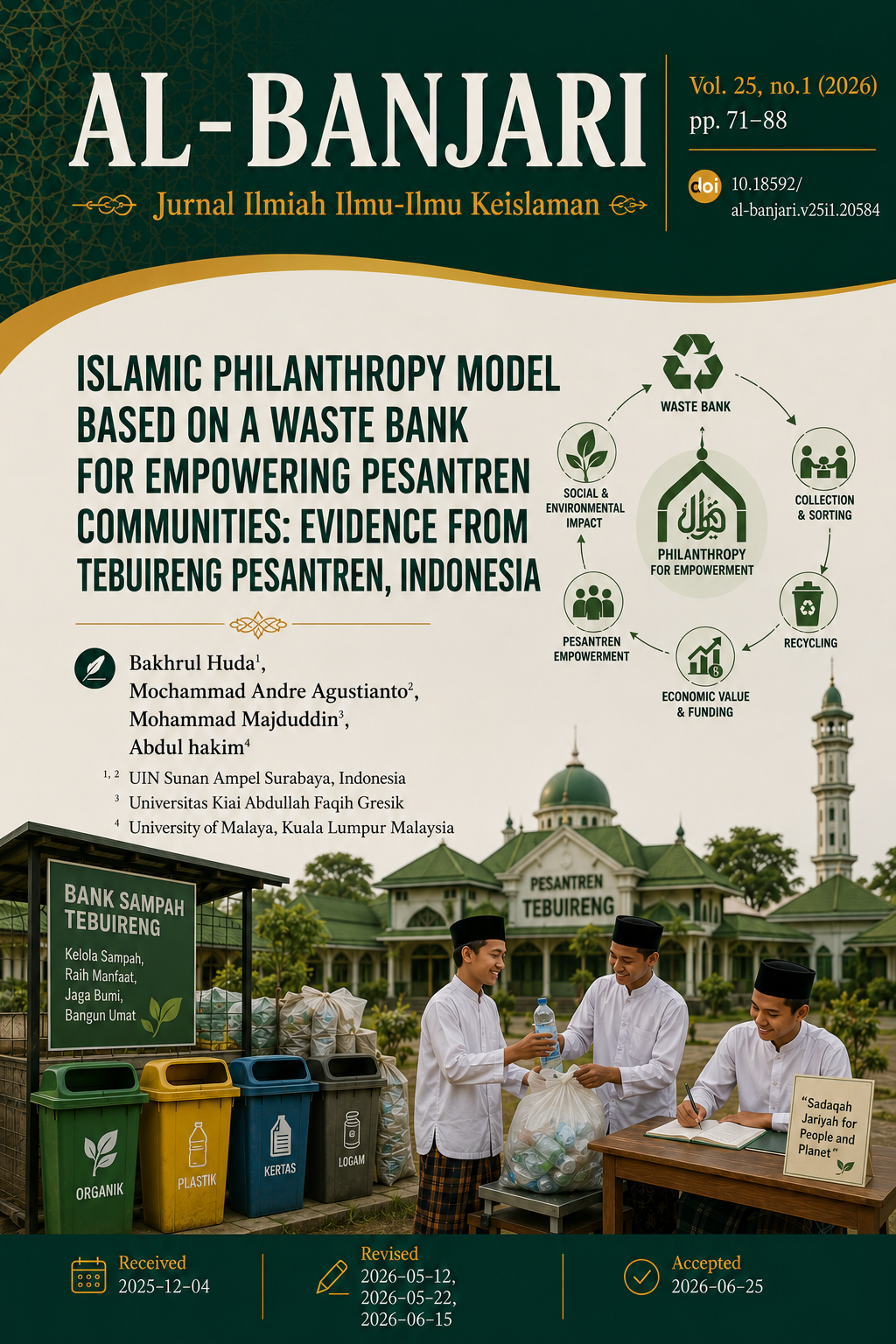
Islamic Philanthropy Model Based on a Waste Bank for Empowering Pesantren Communities: Evidence from Tebuireng Pesantren, Indonesia
DOI:
https://doi.org/10.18592/al-banjari.v25i1.20584Abstract
This study examines the development of an Islamic philanthropy model based on a waste bank system in the context of pesantren-based community empowerment. While previous studies have largely positioned waste banks within environmental management and economic empowerment frameworks, they have given limited attention to their potential role as mechanisms of Islamic social finance. This study addresses this gap by analyzing how economic activities derived from waste management can be transformed into socially oriented philanthropic practices. Using a qualitative approach with an intrinsic case study design, this research was conducted at the Tebuireng Waste Bank (BST), Jombang. Data were collected through in-depth interviews, participant observation, and document analysis involving waste bank managers, pesantren authorities, community participants, and beneficiaries. The data were analyzed using thematic analysis to identify patterns and construct a conceptual model. The findings reveal that BST operates beyond a conventional waste management system by integrating circular economy practices with pesantren values, enabling the transformation of economic value into social value. The proceeds from waste-related activities are collectively managed and implicitly function as a form of productive charity, contributing to social redistribution and community empowerment. This process is mediated by the pesantren's institutional and normative roles, ensuring alignment with Islamic principles such as trustworthiness, justice, and public benefit. This study proposes a conceptual model of Islamic philanthropy grounded in a circular economy framework, in which community participation, economic value creation, and social redistribution are interconnected in a sustainable cycle. The study contributes to the literature by extending the scope of Islamic philanthropy beyond traditional instruments toward community-based and productive practices. It also offers practical insights for developing sustainable empowerment models within Islamic social institutions.
Downloads
Published
Issue
Section
License
Copyright (c) 2026 Bakhrul Huda, Mochammad Andre Agustianto, Mohammad Majduddin, Abdul Hakim

This work is licensed under a Creative Commons Attribution-ShareAlike 4.0 International License.
Authors who publish with this journal agree to the following terms:
- Authors retain copyright and grant the journal right of first publication with the work simultaneously licensed under a Creative Commons Attribution License that allows others to share the work with an acknowledgement of the work's authorship and initial publication in this journal.
- Authors are able to enter into separate, additional contractual arrangements for the non-exclusive distribution of the journal's published version of the work (e.g., post it to an institutional repository or publish it in a book), with an acknowledgement of its initial publication in this journal.
- Authors are permitted and encouraged to post their work online (e.g., in institutional repositories or on their website) prior to and during the submission process, as it can lead to productive exchanges, as well as earlier and greater citation of published work (See The Effect of Open Access).






 This work is licensed under a