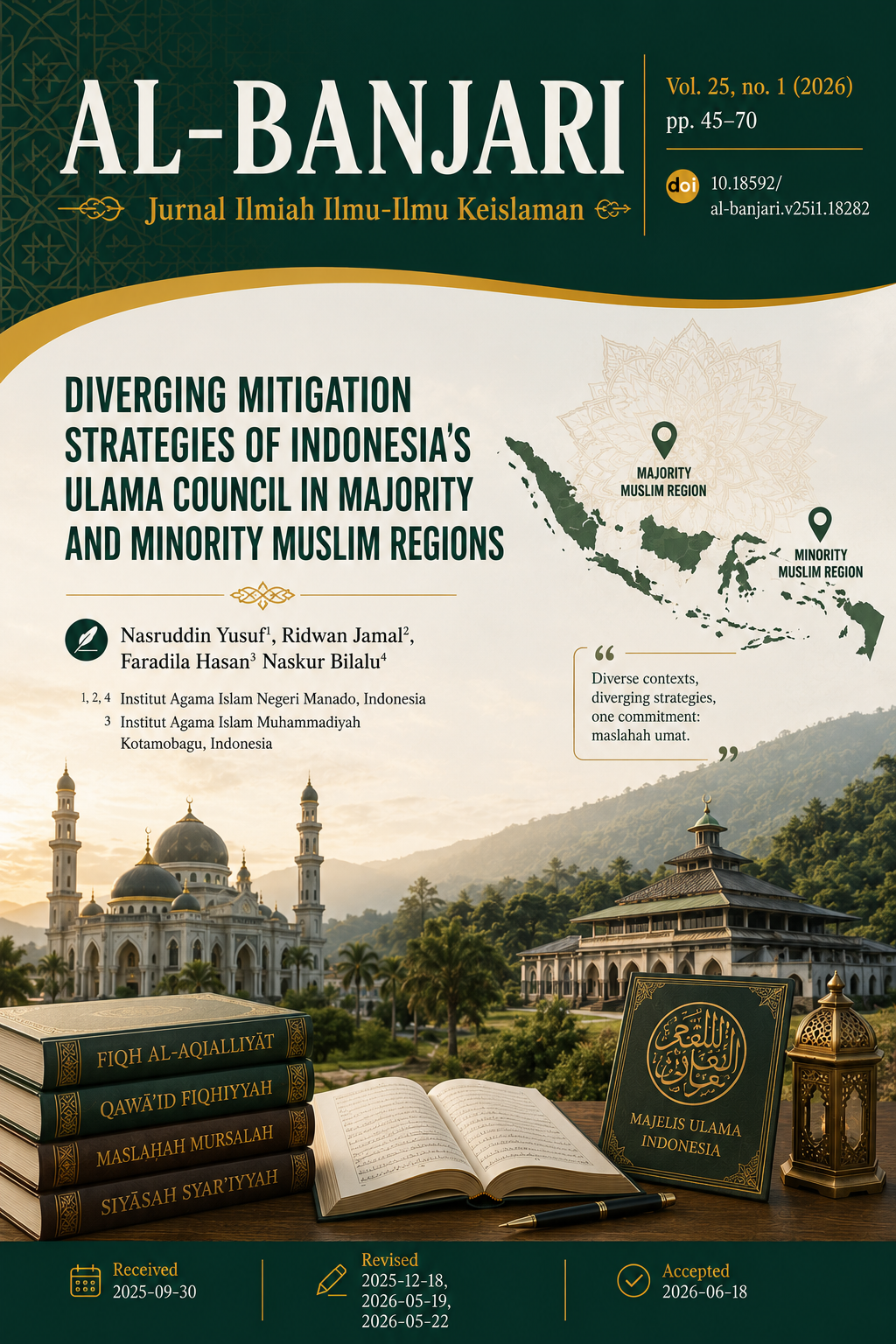
Diverging Mitigation Strategies of Indonesia's Ulama Council in Majority and Minority Muslim Regions
DOI:
https://doi.org/10.18592/al-banjari.v25i1.18282Abstract
Local deviant sects persist across Indonesia's religiously plural regions despite repeated fatwa declarations and enforcement efforts. Prior scholarship has examined MUI's authority and fatwa compliance mainly from a national vantage point, leaving the question of how demographic context shapes mitigation strategy underexplored. This study compares how MUI in Muslim-majority North Sumatra and Muslim-minority North Sulawesi each designs its response to local deviant sects, and asks which approach works under what conditions. Data were gathered through in-depth interviews with MUI officials at the provincial, district, and city levels in both regions, combined with fatwa document analysis and institutional reports. Informants were selected purposively. Source and time triangulation ensured data validity; analysis followed the Miles and Huberman model. North Sumatra MUI relies on a structural-corrective approach backed by formal fatwa decisions and close supervision. This proves effective at enforcing doctrinal boundaries but tends to harden resistance and strengthen internal solidarity among targeted groups. North Sulawesi MUI takes a dialogical-educational route, preserving plural harmony at the cost of slower doctrinal change. In both regions, MUI effectiveness hits the same ceiling: government intervention arrives only after formal legal violations occur, stretching the mitigation timeline and diluting preventive effectiveness. The demographic position of Muslims in a region determines which tools are available, which risks are tolerable, and what counts as success. Mitigation strategy cannot be standardized. The study contributes an adaptive, context-sensitive model of religious governance to the comparative study of Islamic institutions in Southeast Asia
Downloads
Published
Issue
Section
License
Copyright (c) 2026 Nasruddin Yusuf, Ridwan Jamal, Faradila Hasan

This work is licensed under a Creative Commons Attribution-ShareAlike 4.0 International License.
Authors who publish with this journal agree to the following terms:
- Authors retain copyright and grant the journal right of first publication with the work simultaneously licensed under a Creative Commons Attribution License that allows others to share the work with an acknowledgement of the work's authorship and initial publication in this journal.
- Authors are able to enter into separate, additional contractual arrangements for the non-exclusive distribution of the journal's published version of the work (e.g., post it to an institutional repository or publish it in a book), with an acknowledgement of its initial publication in this journal.
- Authors are permitted and encouraged to post their work online (e.g., in institutional repositories or on their website) prior to and during the submission process, as it can lead to productive exchanges, as well as earlier and greater citation of published work (See The Effect of Open Access).






 This work is licensed under a