The Impact of Knowledge Management and Organizational Learning on Competitive Advantage: Evidence from Sasirangan MSMEs in Banjarmasin
DOI:
https://doi.org/10.18592/albanjari.v24i2.17956Abstract
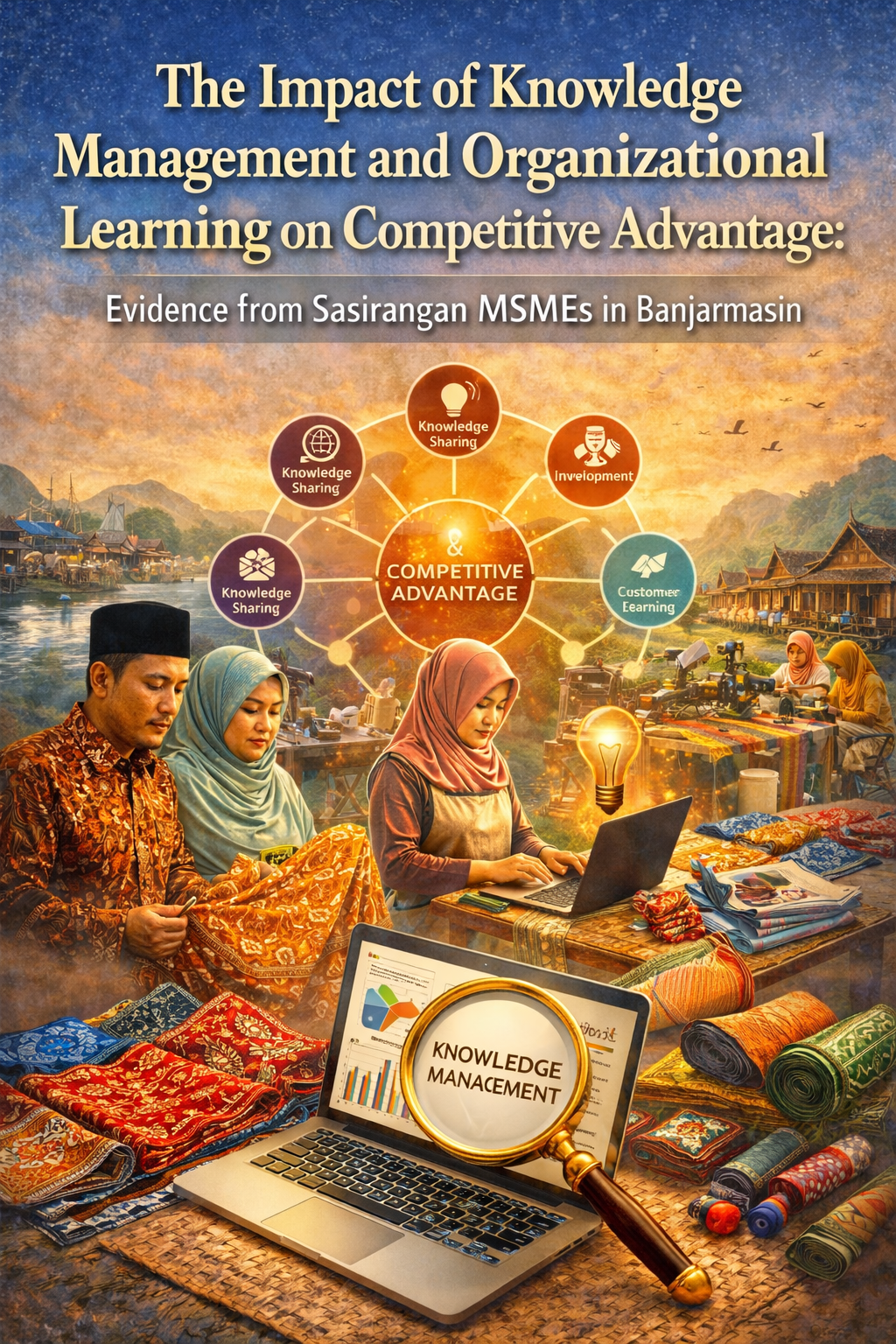
This study investigates the influence of knowledge management and organizational learning on the competitive advantage of Sasirangan MSMEs in Banjarmasin, with organizational innovation functioning as a mediating variable. Although previous research has extensively examined these constructs in various industrial contexts, empirical evidence linking knowledge management, organizational learning, innovation, and competitive advantage within culturally based MSMEs—particularly Sasirangan craft enterprises—remains limited. Using a quantitative approach, data were collected from 139 MSME actors through structured questionnaires and analyzed using PLS-SEM. The results indicate that knowledge management and organizational learning significantly enhance organizational innovation, which in turn strengthens competitive advantage. Organizational innovation is also found to significantly mediate the relationship between both antecedent variables and competitive advantage. These findings contribute to the resource-based view and knowledge-based view frameworks by demonstrating that innovation capability is a critical pathway through which internal knowledge processes create competitive value in micro-scale creative industries. Practically, the study highlights the need for structured knowledge management systems, continuous learning mechanisms, and innovation-oriented organizational cultures to support the sustainability and competitiveness of Sasirangan MSMEs in evolving markets.
Downloads
Published
Issue
Section
License
Copyright (c) 2025 Muhammad Hilman Salsabila, Mochammad Musadieq , Ika Ruhana

This work is licensed under a Creative Commons Attribution-ShareAlike 4.0 International License.
Authors who publish with this journal agree to the following terms:
- Authors retain copyright and grant the journal right of first publication with the work simultaneously licensed under a Creative Commons Attribution License that allows others to share the work with an acknowledgement of the work's authorship and initial publication in this journal.
- Authors are able to enter into separate, additional contractual arrangements for the non-exclusive distribution of the journal's published version of the work (e.g., post it to an institutional repository or publish it in a book), with an acknowledgement of its initial publication in this journal.
- Authors are permitted and encouraged to post their work online (e.g., in institutional repositories or on their website) prior to and during the submission process, as it can lead to productive exchanges, as well as earlier and greater citation of published work (See The Effect of Open Access).






 This work is licensed under a