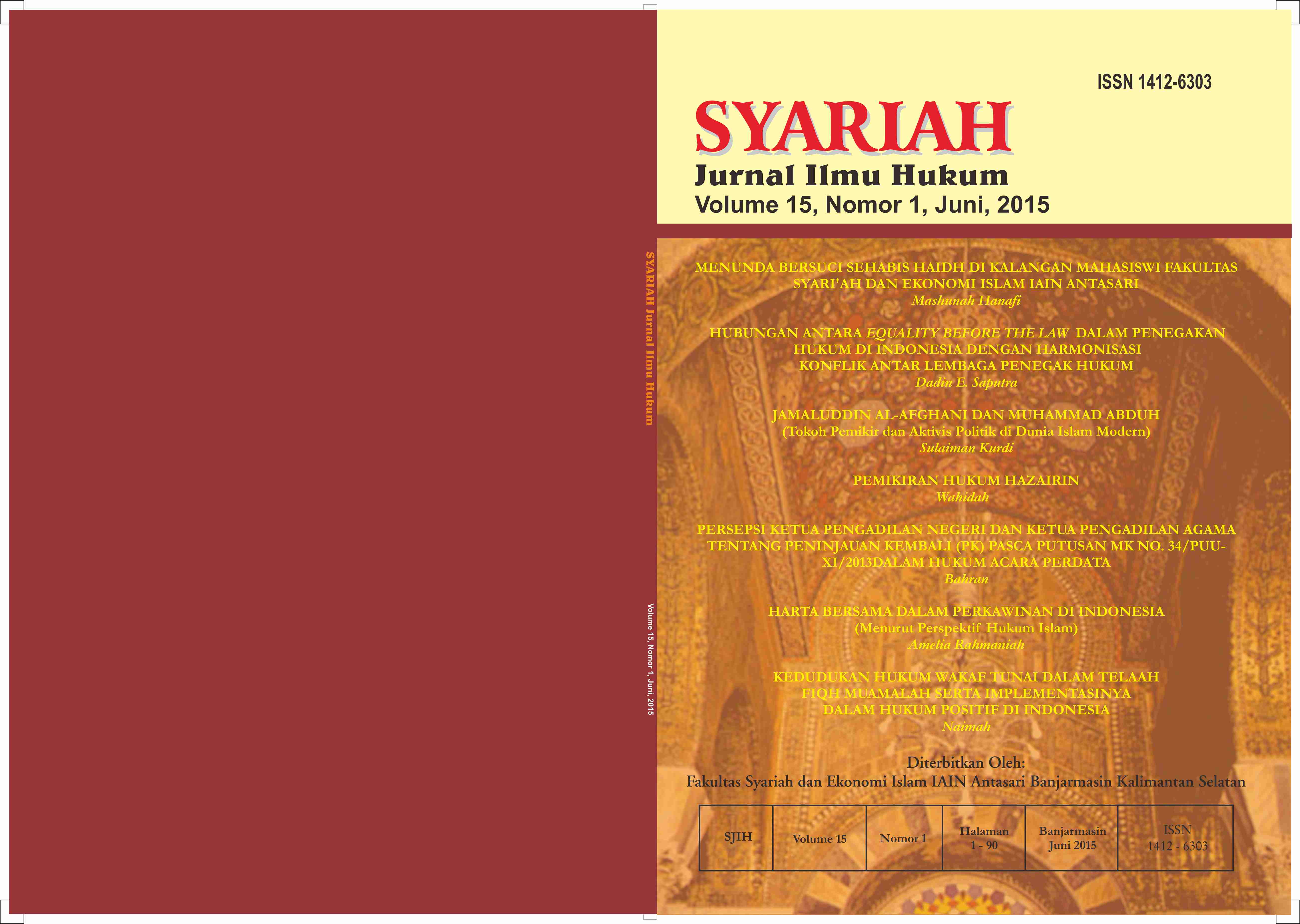
PERSEPSI KETUA PENGADILAN NEGERI DAN KETUA PENGADILAN AGAMA TENTANG PENINJAUAN KEMBALI (PK) PASCA PUTUSAN MK NO. 34/PUU-XI/2013 DALAM HUKUM ACARA PERDATA
DOI:
https://doi.org/10.18592/syariah.v15i1.543Abstract
Since test material to the provisions of Pasal 268 ayat (3) Undang-Undang No. 8 Tahun 1981
on Criminal Proceedings in Mahkamah Konstitusi, Mahkahmah decided in its decision number 34 /
PUU-XI / 2013, which states that the provisions was inconsistent with the Undang-Undang Dasar
1945, so it does not have binding legal force. Therefore, Peninjauan Kembali (PK) in criminal cases may
be done more than once with the new circumstances or conditions found substantial novum new found
during previous PK undiscovered. If problems associated PK novum criminal case is considered sub-
stantial, and neither should Novum issues related PK in civil cases, as may be after the filing of the PK
and disconnected, no new circumstances or substantial novum recently discovered that during the
previous PK undiscovered or if there is a decision of a judges mistake or a real mistake was discovered
after PK decided. PK is an extraordinary remedy that aims to find justice and truth material. Justice can
not be limited by time or formal provision that limits that PK is only one time. Justice is a very basic
human needs, the more basic human needs of the rule of law. But in civil cases, the results of this study
indicate that the filing PK limited only once.
Downloads
Published
Issue
Section
License
Authors who publish with this journal agree to the following terms:
- Authors retain copyright and grant the journal right of first publication with the work simultaneously licensed under a Creative Commons Attribution License that allows others to share the work with an acknowledgement of the work's authorship and initial publication in this journal.
- Authors are able to enter into separate, additional contractual arrangements for the non-exclusive distribution of the journal's published version of the work (e.g., post it to an institutional repository or publish it in a book), with an acknowledgement of its initial publication in this journal.
- Authors are permitted and encouraged to post their work online (e.g., in institutional repositories or on their website) prior to and during the submission process, as it can lead to productive exchanges, as well as earlier and greater citation of published work.
Â