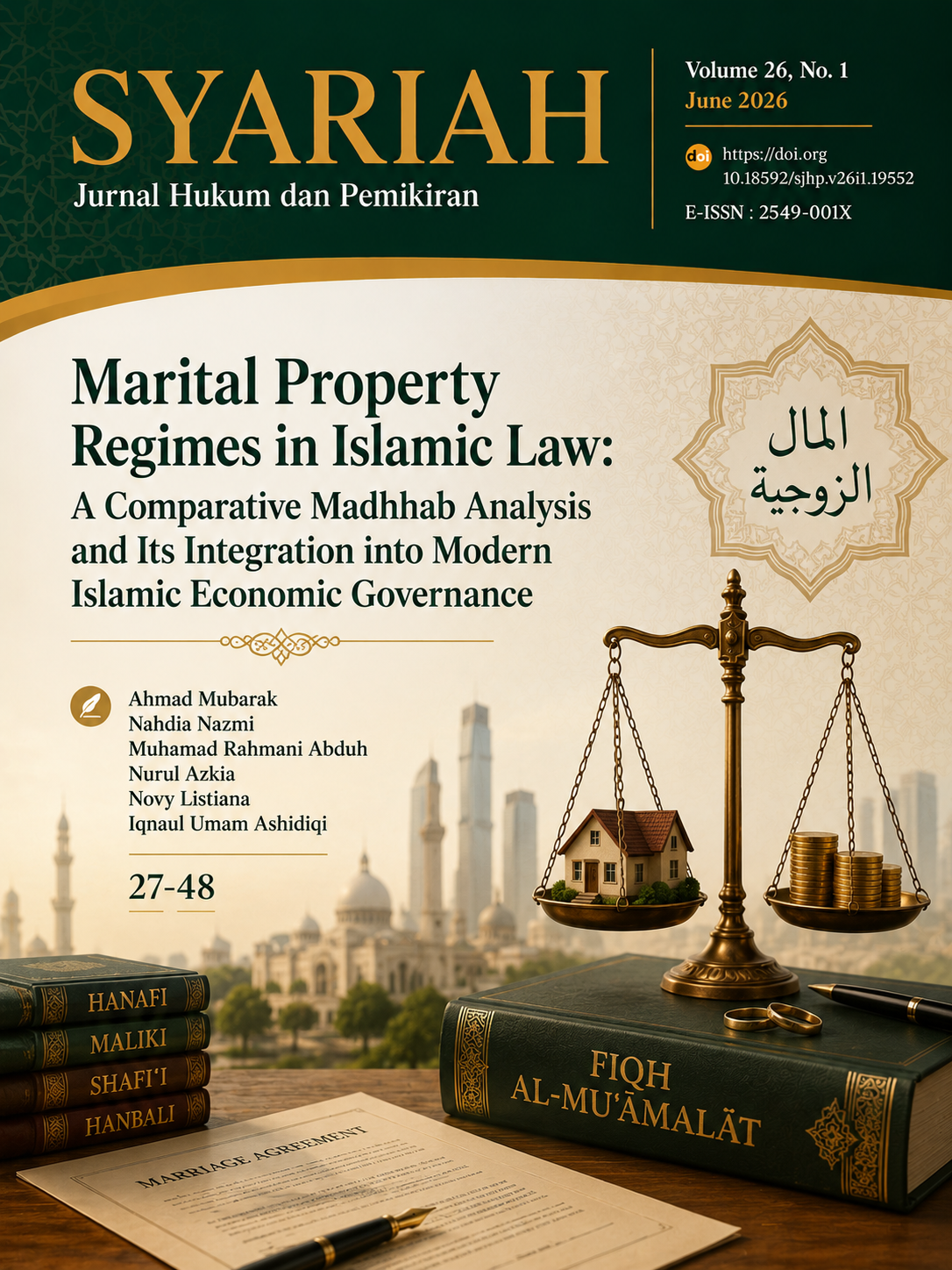
Marital Property Regimes in Islamic Law: A Comparative Madhhab Analysis and Its Integration into Modern Islamic Economic Governance
DOI:
https://doi.org/10.18592/sjhp.v26i1.20553Keywords:
marital property, Islamic family law, comparative madhhab, islamic economic law, state governanceAbstract
The economic transformation of contemporary Muslim families has significantly reshaped the ownership, management, and distribution of property within marriage. This development has generated legal tension where classical fiqh, which generally upholds separate ownership between spouses, confronts the realities of dual-income households, women’s economic contribution, and increasing state intervention in the pursuit of family justice. Marital property must therefore be understood not merely as a matter of private law, but as an issue located at the intersection of Islamic family law, Islamic economic law, comparative madhhab analysis, and state legal governance. This article aims to analyse the normative construction of marital property regimes across the Sunni madhhabs, examine their integration into modern state law, and formulate a more just and context-sensitive conceptual model. The study employs a qualitative legal research design based on a doctrinal-comparative approach, complemented by a limited socio-legal perspective. Data were collected through systematic library research and documentary legal research, and analysed through qualitative content analysis, comparative legal analysis, and normative-constructive analysis. The findings show that classical Islamic law does not recognise the automatic fusion of property by virtue of marriage, yet it provides normative resources through milkiyyah, shirkah, ‘urf, nafaqah, and maqāṣid al-sharīʿah to acknowledge entitlements arising from both direct and indirect contribution. The central problem lies not in the absence of Islamic norms, but in the weak translation of those norms into fair adjudicative methods and state policy. This article proposes a maqāṣid-based relational marital property regime that balances individual ownership, economic and domestic contribution, the social function of family assets, and equitable adjustment. It concludes that reform of marital property law should move towards interpretations that are more responsive to contribution, child protection, and the economic governance of modern Muslim families.
References
Abdullah, A. (2019). The Dynamism of Fiqh of Property in Malaysia. https://doi.org/10.15405/epsbs.2019.09.45
Akbar, W., & Kurniawan, R. (2023). Marital Property in Indonesia (Review of Dayak Ngaju Customary Law). Jurnal Ilmu Hukum Tambun Bungai, 8(1), 228–244. https://journal.stihtb.ac.id/index.php/jihtb/article/download/250/94/
Akhtar, R. C., & Manjoo, F. A. (2024). Matrimonial Property in Islamic Law. https://doi.org/10.4337/9781802204681.00012
Al-Sharmani, M. (2018). Marriage in Islamic Interpretive Tradition: Revisiting the Legal and the Ethical. Journal of Islamic Ethics, 2(1), 76–96. https://doi.org/https://doi.org/10.1163/24685542-12340017
Alfitri, A. (2015). Whose Authority? Contesting and Negotiating the Idea of a Legitimate Interpretation of Islamic Law in Indonesia. In Asian Journal of Comparative Law. https://doi.org/10.1017/asjcl.2016.1
Ali, Z., Ibrahim, N., Ghadas, Z. A. A., & Nong, S. N. A. S. (2021). Law of Trust and the Beneficial Interest in Matrimonial Property. In Pertanika Journal of Social Sciences and Humanities. https://doi.org/10.47836/pjssh.29.s2.08
Arrasyid, F., Pagar, P., & Tanjung, D. (2024). Islamic Family Law Reform in Indonesia Through Supreme Court Circulars: A Maqasid Sharia Perspective. In Ulul Albab Jurnal Studi Dan Penelitian Hukum Islam. https://doi.org/10.30659/jua.v6i2.29236
Azani, M. (2021). The Development of Islamic Law in Indonesia Through Traditional Theory and Legal Changes. In Jurnal Mahkamah Kajian Ilmu Hukum Dan Hukum Islam. https://doi.org/10.25217/jm.v6i2.1626
Behr, D. M., & Braunmiller, J. C. (2025). Changing Laws, Changing Lives: Family Law Reform as a Catalyst for Economic Prosperity. Global Indicators Brief, 30.
Bosheya, M. S. M. (2021). Matrimonial Property and Legality of Claiming It Between Fiqh and the Laws of Malaysia, Morocco and Tunisia. In Linguistics and Culture Review. https://doi.org/10.21744/lingcure.v5ns4.1918
Dahlgren, S., & Lindbekk, M. (2020). Introduction. In Hawwa. https://doi.org/10.1163/15692086-12341374
Denson, R. (2021). A Comparative Exposition of the Law of Husband and Wife in Terms of Islamic Law, South African Law and the Law of England and Wales. In Obiter. https://doi.org/10.17159/obiter.v41i4.10485
Fuad, H. Z., Luth, T., Hamidah, S., & Sulistyarini, R. (2023). Application of Contra Legem Principles in Judicial Rulings on Joint Property Characteristics. Ascarya: Journal of Islamic Science, Culture, and Social Studies, 3(2), 128–140.
Haisyi, N. (2023). Examining the Application of Al-’Urf in Islamic Financial Contracts: Insights and Implications for Modern Banking Products. In At-Taradhi Jurnal Studi Ekonomi. https://doi.org/10.18592/at-taradhi.v14i1.10246
Hidayah, N. (2023). Gender, Economy, and the Law: Women Entrepreneurs in Indonesian and Islamic Legal Perspectives. In Samarah Jurnal Hukum Keluarga Dan Hukum Islam. https://doi.org/10.22373/sjhk.v7i2.17944
Hussin, M. N. M., Arifah, R. N., Aisyah, S., Daud, M. Z., & Samah, M. (2025). Local Wisdom and Gender Equality in Joint Property Division: An Islamic Legal Perspective from Malaysia. De Jure: Jurnal Hukum Dan Syar’iah, 17(2), 394–416.
Hussin, M. N. M., & Daud, M. Z. (2020). SEJARAH DAN PERKEMBANGAN AMALAN PEMBAHAGIAN HARTA SEPENCARIAN DALAM MASYARAKAT ISLAM DI MALAYSIA (History and Development of Harta Sepencarian Distribution Practice in Muslims Society in Malaysia). Journal of Al-Tamaddun, 15(2), 95–113.
Ishak, M. S. I., & Asni, F. (2020). The Role of maqasid Al-Shariʿah in Applying fiqh Muamalat Into Modern Islamic Banking in Malaysia. In Journal of Islamic Accounting and Business Research. https://doi.org/10.1108/jiabr-12-2019-0224
Jamaludin, M. H., & Buang, A. H. (2014). Syariah Courts in Malaysia and the Development of Islamic Jurisprudence: The Study of Istihsan. In International Journal of Nusantara Islam. https://doi.org/10.15575/ijni.v1i1.33
Kamarusdiana, K. (2018). Disparity in the Judge’s Ruling About Community Property Disputes After Divorce (An Analysis of the Verdict in the South Jakarta Religious Court, Religious Court of Jakarta and Supreme Court). In Jurnal Cita Hukum. https://doi.org/10.15408/jch.v6i1.8266
Kasumawati, D., & Manfaluti, A. (2026). HARTA PERPANTANGAN SEBAGAI LIVING LAW MASYARAKAT BANJAR (Analisis Normatif-Empiris Terhadap Asal-Usul dan Praktik Pembagiannya). Hakam: Jurnal Kajian Hukum Islam Dan Hukum Ekonomi Islam, 10(1).
Khoirin, N. (2018). Marriage Treasure Ownership in Arabic and Nusantara Fiqh Perspectives. In Addin. https://doi.org/10.21043/addin.v12i2.4543
Kusmardani, A., Khosyi’ah, S., Mukhlas, O. S., Nurrohman, N., & Saepullah, U. (2023). The Development of Ideas on the Reform and Transformation of Islamic Family Law Into Legislation in Islamic Countries. In Jurnal Syntax Imperatif Jurnal Ilmu Sosial Dan Pendidikan. https://doi.org/10.36418/syntax-imperatif.v4i5.296
Lohlker, R. (2021). Fiqh Reconsidered: Indigenization and Universalization of Islamic Law in Indonesia. In Interdisciplinary Journal for Religion and Transformation in Contemporary Society. https://doi.org/10.30965/23642807-bja10011
Mashdurohatun, A., & Busro, A. (2024). Settlement of Joint Property Disputes Resulting From Divorce in the Religious Courts. https://doi.org/10.7176/jlpg/141-01
Maula, B. S., Zain, M. F., & Nada, S. (2024). Marital property in marriages of different nationalities in Indonesia according to national law and Islamic law. El-Aqwal: Journal of Sharia and Comparative Law, 1–16.
Mawardi, A. I., & Riza, A. K. (2019). WHY DID KOMPILASI HUKUM ISLAM SUCCEED WHILE ITS COUNTER LEGAL DRAFT FAILED? A Political Context and Legal Arguments of the Codification of Islamic Law for Religious Courts in Indonesia. In Journal of Indonesian Islam. https://doi.org/10.15642/jiis.2019.13.2.421-453
Moawad, A. T. M. K. (n.d.). The Extent of ‘Urf’s Authority in Establishing the Legality of Matrimonial Property. Linguistics and Culture Review, 5(S4), 2259–2265.
Mohd, A. (2019). An Appraisal of the Application of Fiqh Al-Hanafi Under Islamic Family Law (Federal Territories) Act 1984. In Iium Law Journal. https://doi.org/10.31436/iiumlj.v27i2.459
Mokhtar, H. M. N. H. (2023). Achieving Justice Through Implementation of Shariah: Challenges and the Way Forward. In Iium Law Journal. https://doi.org/10.31436/iiumlj.v31i2.900
Mokodenseho, S., Siregar, R., Muslim, S., Hasibuan, K., & Rahman, R. (2024). Analysis of the Influence of Fiqh and Maqasid Al-Syariah in the Formation of Islamic Legal Policy in Indonesia. In West Science Islamic Studies. https://doi.org/10.58812/wsiss.v2i01.590
Muhammad, C. L., & Duderija, A. (2022). Understanding the Context and Concept of Islam Nusantara. In Icr Journal. https://doi.org/10.52282/icr.v13i1.912
Murtadlo, M. A. (2020). Islamic Family Law Reform in Indonesia. https://doi.org/10.31219/osf.io/3n57z
Muslimin, J. M., & Fatma, Y. (2020). The Actualization of Justice in the Settlement of Joint Assets Due to Divorce: Comparative Analysis of Decisions of the Religious Courts. In De Jure Jurnal Hukum Dan Syar Iah. https://doi.org/10.18860/j-fsh.v12i2.9064
Najib, A. M. (2020). Reestablishing Indonesian Madhhab: ‘Urf and the Contribution of Intellectualism. In Al-Jami Ah Journal of Islamic Studies. https://doi.org/10.14421/ajis.2020.581.171-208
Noor, Z., Zaman, M. A. K., & Husain, H. (2023). An analysis of harta sepencarian cases in the syariah high court of Ipoh. UMRAN-Journal of Islamic and Civilizational Studies, 10(3), 87–102.
Nur, I., A’dam, S., & Muttaqien, M. N. (2020). Maqāṣid Al-Sharī‘at: The Main Reference and Ethical-Spiritual Foundation for the Dynamization Process of Islamic Law. In Ahkam Jurnal Ilmu Syariah. https://doi.org/10.15408/ajis.v20i2.18333
Oktaber, Y. (2023). The Implementation of National Regulations on the Division of Joint Property During Divorce. In Indonesian Private Law Review. https://doi.org/10.25041/iplr.v4i1.2945
Pelu, I. E. A. S., & Dakhoir, A. (2021). Marital Property within the Marriage Law: A Debate on Legal Position and Actual Applications. Al-Jami’ah: Journal of Islamic Studies, 59(2), 287–316.
Rahman, M., Fathudin, F., & Basit, A. W. (2022). Transformation of Sharia Economy in the Populist System. In International Journal of Economics Business and Accounting Research (Ijebar). https://doi.org/10.29040/ijebar.v6i1.4390
Rais, I. (2019). The Settlement of Joint Property in Religious Courts of Indonesia (A Case in the Religious Court of South Jakarta). In Al- Adalah. https://doi.org/10.24042/adalah.v15i2.2484
Reskiani, A., Tenrilawa, D. F., Aminuddin, A., & Subha, R. (2022). Konstruksi Pemikiran Pembaharuan Hukum Kewarisan Islam Di Indonesia (Studi Yurisprudensi Mahkamah Agung). In Juris (Jurnal Ilmiah Syariah). https://doi.org/10.31958/juris.v21i1.5564
Rinaldo, R., Nisa, E. F., & Nurmila, N. (2023). Divorce Narratives and Class Inequalities in Indonesia. In Journal of Family Issues. https://doi.org/10.1177/0192513x231155657
Ristianawati, E. (2021). Joint Property Distribution Upon Divorce Reviewed From the Contribution of Husband and Wife in the Household. In Walisongo Law Review (Walrev). https://doi.org/10.21580/walrev.2021.3.1.8078
Rouf, A. (2024). Jurimetrics in the Reconstruction of the Joint Property Division Model for Wage-Earner Wives in Indonesia. Al-Ahkam, 34(1), 1–32.
Rouf, A., Cholil, M., & Mahmudi, Z. (2023). Joint Property Division in Indonesia: A Gender Equality Viewpoint. De Jure: Jurnal Hukum Dan Syari’ah, 15(2), 230–250.
Seli, A. R., Kusmayanti, H., & Pujiwati, Y. (2025). The Obligation of a Father in Fulfilling Nafaqah Māḍiyah and Nafaqah Ḥaḍānah for Children Post-Divorce in Relation to Relevant Legal Regulations. Al-Risalah Jurnal Ilmu Syariah Dan Hukum, 675–691.
Siraji, A. H. A. S., & Halim, M. M. A. (2021). Matrimonial Property. In Linguistics and Culture Review. https://doi.org/10.21744/lingcure.v5ns4.1912
Syuhadak, F., Nasrulloh, M., Sholehuddin, M., & Ermawan, M. Z. U. (2026). Reformulation of Joint Marital Property Regimes for the Protection of Female Migrant Workers: Empirical Evidence from Malang Regency. PALASTREN: Jurnal Studi Gender, 18(2), 153–176.
Visser, H. (2019). The Islamic Economy: Its Origin, Its World View and Its Claims. In The Central European Review of Economics and Management. https://doi.org/10.29015/cerem.765
Wirastri, T. D., & Van Huis, S. C. (2024). The State of Indonesia’s Marriage Law: 50 Years of Statutory and Judicial Reforms. AHKAM: Jurnal Ilmu Syariah, 24(2), 215–232.
Downloads
Published
Issue
Section
License
Copyright (c) 2026 Ahmad Mubarak, Nahdia Nazmi, Muhamad Rahmani Abduh, Nurul Azkia, Novy Listiana, Iqnaul Umam Ashidiqi

This work is licensed under a Creative Commons Attribution 4.0 International License.
Authors who publish with this journal agree to the following terms:
- Authors retain copyright and grant the journal right of first publication with the work simultaneously licensed under a Creative Commons Attribution License that allows others to share the work with an acknowledgement of the work's authorship and initial publication in this journal.
- Authors are able to enter into separate, additional contractual arrangements for the non-exclusive distribution of the journal's published version of the work (e.g., post it to an institutional repository or publish it in a book), with an acknowledgement of its initial publication in this journal.
- Authors are permitted and encouraged to post their work online (e.g., in institutional repositories or on their website) prior to and during the submission process, as it can lead to productive exchanges, as well as earlier and greater citation of published work.
Â