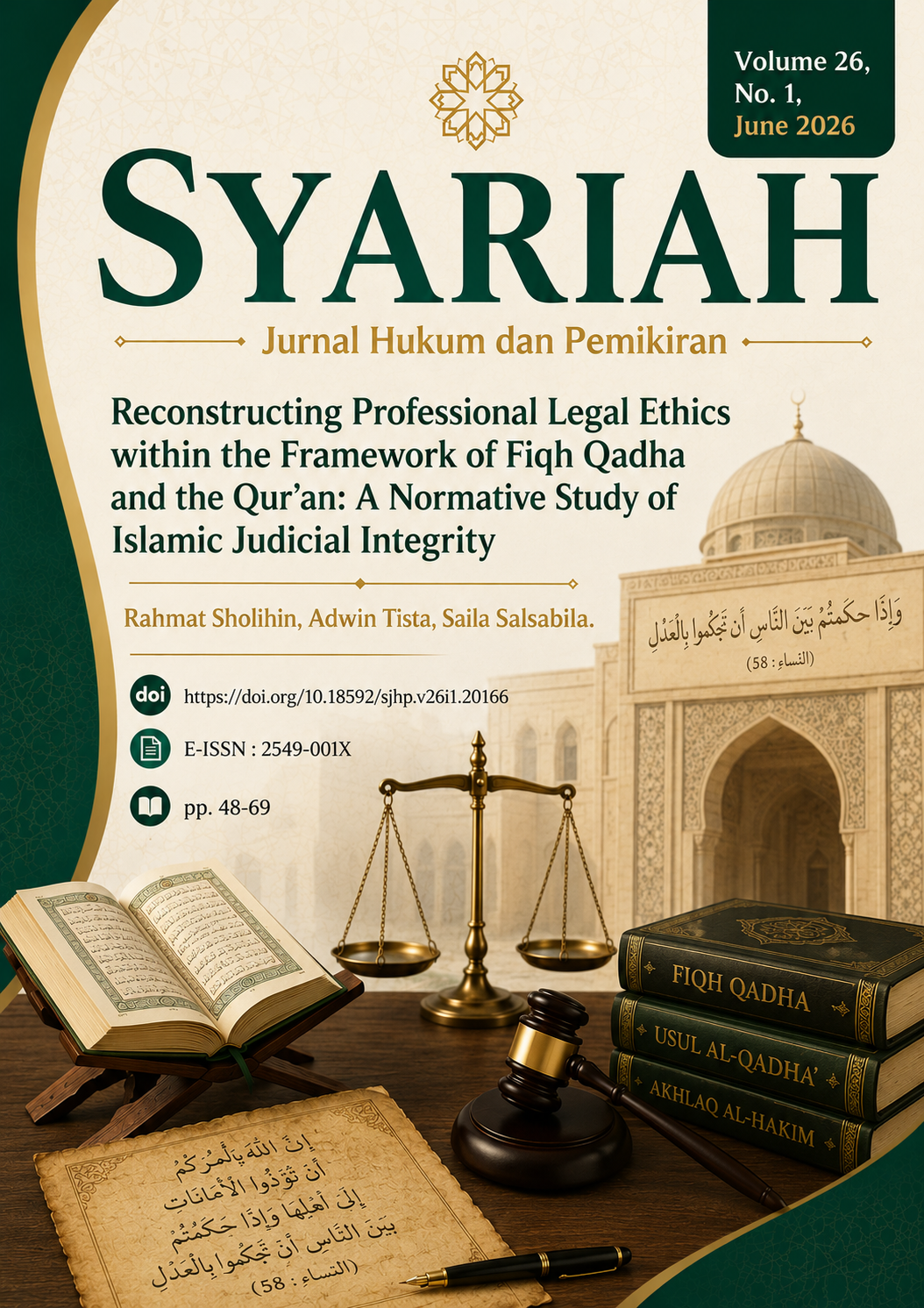
Reconstructing Professional Legal Ethics within the Framework of Fiqh Qadha and Qur'an: A Normative Study of Islamic Judicial Integrity
DOI:
https://doi.org/10.18592/sjhp.v26i1.20166Keywords:
Islamic judicial ethics, Fiqh Qadha, Qur'anic principles, professional integrity, judicial reform, maqasid al-shariahAbstract
The modern judiciary faces an unprecedented crisis of legitimacy, marked by widespread ethical violations, corruption allegations, and declining public trust in judicial institutions across Muslim-majority nations. This phenomenon represents a critical juncture requiring the reconstruction of professional legal ethics grounded in Islamic normative sources, particularly Fiqh Qadha and Qur'anic principles that articulate transcendent standards of judicial integrity.
The theoretical landscape reveals a significant disjuncture between contemporary positive law frameworks and the rich Islamic jurisprudential heritage addressing judicial ethics. Existing scholarship has predominantly examined either the procedural dimensions of Islamic courts or institutional reforms in secular-positivist contexts, leaving unexamined the substantive ethical reconstruction of the judicial profession itself through integrated Qur'anic and Fiqh Qadha principles.
This study aims to systematically reconstruct professional legal ethics within the framework of Fiqh Qadha and Qur'anic principles to establish normative standards for Islamic judicial integrity, examining how classical jurisprudential categories and Qur'anic ethical directives can inform contemporary judicial reform in Muslim societies. Through this reconstruction, the research seeks to create a comprehensive ethical paradigm that simultaneously honors Islamic legal tradition and addresses modern governance challenges.
Employing a normative juridical method grounded in library research, the study engages primary sources including the Qur'an, classical fiqh works, contemporary fatwas, and statutory instruments to conduct a qualitative analysis of judicial ethics principles. The research synthesizes textual hermeneutics with jurisprudential comparison to identify core ethical standards applicable to contemporary judicial practice.
The findings establish that Islamic normative sources articulate a comprehensive ethical framework centered on justice (al-adl), trustworthiness (amanah), intellectual integrity (fathanah), and moral steadfastness (istiqamah), principles that fundamentally exceed the procedural minimalism of many positive law codes. These principles function not merely as behavioral guidelines but as transcendent standards grounding judicial authority in divine accountability, thereby creating a distinctive ethical architecture superior to purely secular frameworks.
The study concludes that reconstructing professional legal ethics through Fiqh Qadha and Qur'anic integration offers a transformative pathway for restoring judicial credibility, strengthening institutional legitimacy, and fostering ethical accountability in Muslim-majority legal systems. The research recommends systematic institutional reform integrating Islamic ethical training, establishing shari'ah-based ethics commissions, and implementing maqasid-aligned oversight mechanisms to operationalize these normative principles in contemporary judicial governance.
References
Abubakar, Yusuf Sani, R H Aji, and M Saidi. “The Principles of Natural Justice: A Comparative Analysis Between Secular and Islamic Law in Administrative Decision-Making” 56 (n.d.). https://doi.org/10.24252/mazahibuna.vi.56855.
Akhtar, Jamil. “Reinterpreting Religious Authority: Women as Islamic Jurists for Addressing Gender Justice in Pakistan.” Women’s Studies International Forum 116 (2026): 103300. https://doi.org/https://doi.org/10.1016/j.wsif.2026.103300.
Al-Ghifari, Abdullah. “Etika Profesi Hakim Dalam Perspektif Peradilan Islam” 2, no. 2 (n.d.). https://doi.org/10.29313/bcsifl.v2i2.2697.
Alam, Lukis. “Negotiating Ethnic and Religious Identities : Indonesian Chinese Muslims in Sharī ’ Ah Compliant Business” 25, no. 1 (2025): 29–54. https://doi.org/10.18326/ijtihad.v25i1.29-54.
Andri Winjaya Laksana Muhammad Ridwan Lubis, Denny Suwondo Muhammad Ngazis Ratih Mega Puspa Sari. “Integrating Maqasid Al-Shariah in Contemporary Islamic Legal Reform on Drug Policy,” n.d. https://doi.org/10.32332/milrev.v4i1.10665.
Bintania, Aris, Rendra Setyadiharja, and Abd. Rahman Mawazi. “Judicial System in the Islamic Judicial Heritage in the Malay World: The Study of Tsamarat Al-Muhimmah, Written by Raja Ali Haji” 7, no. 1 (n.d.). https://doi.org/10.35961/perada.v7i1.1385.
Gaffar, Azis, and Narendra Jumadil Haikal Ramadhan. “Violation of the Prosecutor’s Professional Code of Ethics in the View of Islamic Law and Its Application in Court” 2, no. 3 (n.d.). https://doi.org/10.61677/al-masail.v2i3.299.
Hamdi, Fahmi, Kamel Ladraa, Mounir Ben Jammour, Anwar Hafidzi, and Hamidi Ilhami. “Integrating Maqashid Al-Sharia, Fiqh Al-Biah, and Islamic Ethics for Sustainable Water Management” 10, no. 1 (n.d.). https://doi.org/10.22515/alahkam.v10i1.11277.
Ibrahim, Faisol Mahmoud Adam, and Moh Aziz Arifin. “The Quran and Positive Law: A Philosophical Review in a Normative Legal Perspective” 4, no. 1 (n.d.). https://doi.org/10.32503/klausula.v4i1.7036.
Iffan, Mustafid Ahmad, Ali Hasan, Ahmad Addary Padangsidimpuan, and others. “Justice in Human Rights Courts: Integrating the Concept of Islamic Judiciary and the Principles of International Law” 5, no. 2 (n.d.). https://doi.org/10.47945/muadalah.v5i2.2293.
Ilhamuna, Mohammad. “Modernizing Islamic Judicial Administration in the Contemporary Era: An Analysis of Responsive Law and Siyasah Idriyyah” 7, no. 1 (n.d.). https://doi.org/10.20885/mawarid.vol7.iss1.art7.
Irham. “Integrative Research of Islamic Studies in Indonesian Islamic Higher Education.” Social Sciences & Humanities Open 13 (2026): 102689. https://doi.org/https://doi.org/10.1016/j.ssaho.2026.102689.
Nabilah, Wardatun, Ja’far Shodiq, and Deri Rizal. “Basic Analysis of the Exercise of Judicial Power (Integration of Islamic Law and Positive Law)” 12, no. 1 (n.d.). https://doi.org/10.30736/ji.v12i1.279.
Nomuulin, Ochirbat, and Sodovsuren Narangerel. “Legal and Judicial Ethics: Issues of Professional Responsibility and Integrity” 1209 (n.d.). https://doi.org/10.14738/assrj.1209.19437.
Okumuş, Hacer Şaduman, and Mustafa Alper Gümüş. “Revitalizing ‘mahr’ for Muslim Women’s Empowerment within Türkiye’s Secular Legal System.” Social Sciences & Humanities Open 12 (2025): 101644. https://doi.org/https://doi.org/10.1016/j.ssaho.2025.101644.
Putra Satriya, Muhamad Raka, and M Junaidi. “Urgensi Etika Profesi Hakim Dalam Pandangan Hukum Islam Sebagai Upaya Penegakan Keadilan Di Indonesia” 4, no. 4 (n.d.). https://doi.org/10.58578/ahkam.v4i4.7515.
Rusdi Rizki Lubis Asmuni Asmuni, Tamyiz Mukarrom Candra Boy Seroza M Irfan. “Reconstruction of Obligatory Bequest in the Perspective of the Objectives of Islamic Law: Contextualizing Islamic Law in a Case Study of The Secret Wife in Polygamous Marriage,” n.d. https://doi.org/10.29300/mzn.v12i1.3809.
Sugiarto, Windhu, Suparto Wijoyo, Sendy Ayu Mitra Uktutias, and Antoni Julian. “Strengthening Ethical Responsibility in the Prosecutor’s Office: A Comparative Study of Positive Law and Islamic Legal Principles” 10, no. 2 (n.d.). https://doi.org/10.29240/jhi.v10i2.13123.
Syiar, Irman, Indera Dewi, Fifi Loanardy, Jamil Khairunnisah, and Bilal Hussain. “Judicial Neutrality in Corruption Trials: A Contemporary Islamic Law Perspective on Independence in Transitional Legal Systems” 4, no. 2 (n.d.). https://doi.org/10.32332/milrev.v4i2.11425.
Wutsqah, Urwatul. “Bridging Islamic Legal Ethics and Humanitarian Values in Judicial Governance: Exploring the Ethical Role of Indonesia’s Judicial Commission in Preserving Integrity and Human Dignity” 1, no. 2 (n.d.). https://doi.org/10.64268/jilhs.v1i2.54.
Downloads
Published
Issue
Section
License
Copyright (c) 2026 Rahmat Sholihin, Adwin Tista, Saila Salsabila

This work is licensed under a Creative Commons Attribution 4.0 International License.
Authors who publish with this journal agree to the following terms:
- Authors retain copyright and grant the journal right of first publication with the work simultaneously licensed under a Creative Commons Attribution License that allows others to share the work with an acknowledgement of the work's authorship and initial publication in this journal.
- Authors are able to enter into separate, additional contractual arrangements for the non-exclusive distribution of the journal's published version of the work (e.g., post it to an institutional repository or publish it in a book), with an acknowledgement of its initial publication in this journal.
- Authors are permitted and encouraged to post their work online (e.g., in institutional repositories or on their website) prior to and during the submission process, as it can lead to productive exchanges, as well as earlier and greater citation of published work.
Â