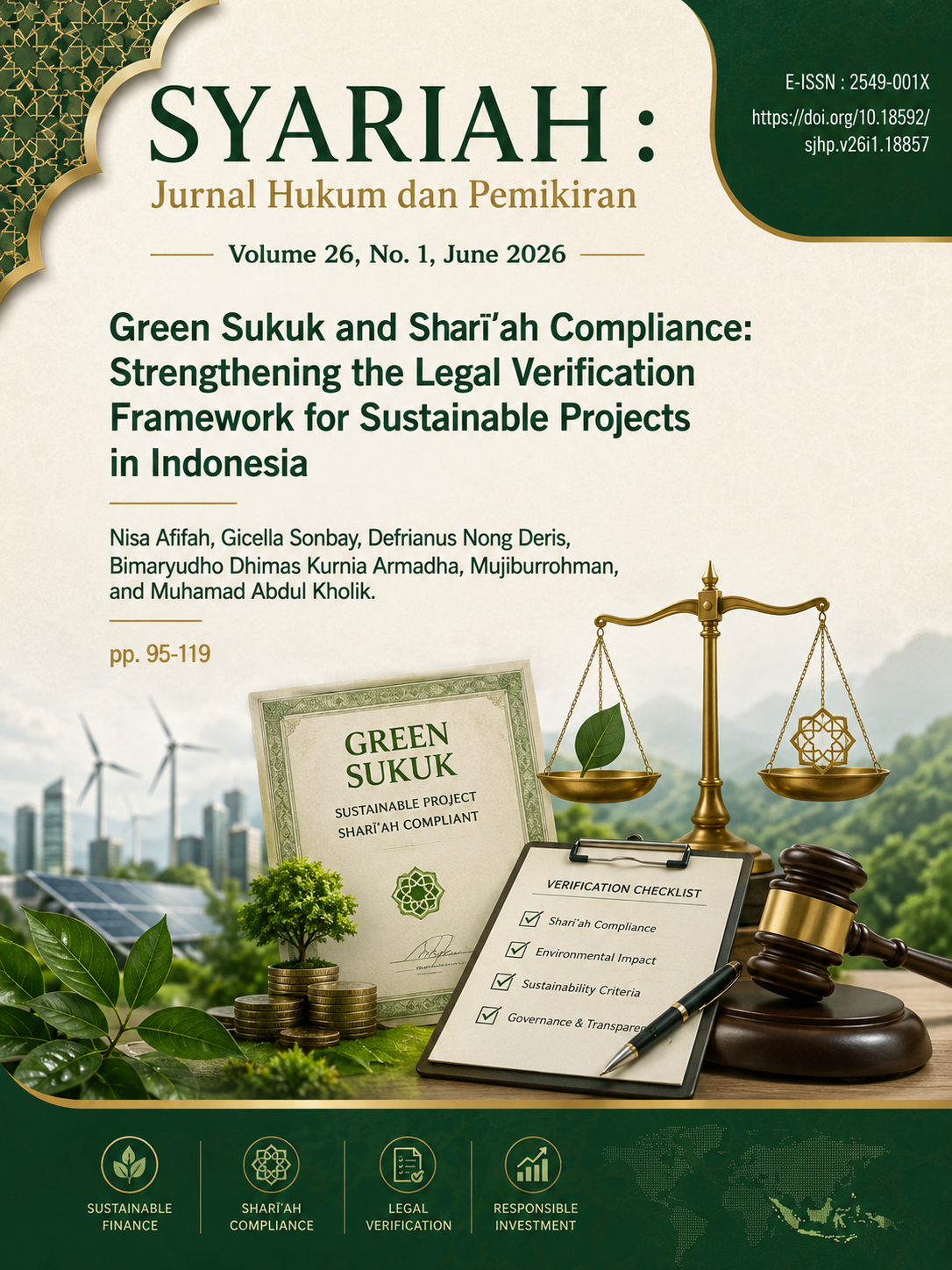
Green Sukuk and Sharī‘ah Compliance: Strengthening the Legal Verification Framework for Sustainable Projects in Indonesia
DOI:
https://doi.org/10.18592/sjhp.v26i1.18857Keywords:
Green Sukuk, Sharia Compliance, Maqāṣid al-Sharī‘ah, Sustainable Finance Regulation.Abstract
Indonesia’s green sukuk has been widely promoted as an innovation in sustainable Islamic finance. However, behind this development remain structural problems related to regulatory fragmentation, verification gaps, and the risk of greenwashing that threaten legal certainty, accountability, and investor confidence. Amid growing international debates on sustainable finance regulation, Islamic financial governance, and sharia-based environmental accountability, there is still no legal framework that operationally integrates maqāṣid al-sharī‘ah principles with measurable sustainability verification mechanisms. This study examines three main issues, namely the conceptualization of green sukuk within sharia business law, the weaknesses of environmental sharia verification mechanisms in Indonesia, and the formulation of an ideal legal framework capable of ensuring measurable dual compliance between environmental sustainability and sharia principles. The research employs a normative juridical method using conceptual and comparative approaches through the analysis of the Sovereign Sukuk Law, Financial Services Authority Regulation Number 18 of 2015, DSN-MUI Fatwa Number 122 of 2018, the Indonesian Green Sukuk Framework, and comparative practices in Malaysia and the United Kingdom. The findings demonstrate that the current legal framework only establishes formal conformity between green sukuk and sharia principles without operationalizing maqāṣid al-sharī‘ah as technical evaluative indicators. The system also maintains a separation between sharia audits and environmental audits and lacks a national institution responsible for coordinating environmental sharia verification, thereby creating opportunities for greenwashing practices. In response, this study proposes the establishment of the National Green Sharia Audit Board and the National Standard for Green Sukuk Sharia Verification as mechanisms for translating maqāṣid al-sharī‘ah into substantive dual compliance indicators. The study contributes to the development of Islamic financial law by shifting the paradigm from formal normative compliance toward substantive and functional compliance within sustainable Islamic finance governance.
References
Ali, Mohammad Mahbubi, Aam Slamet Rusydiana, Aisyah As-Salafiyah, and Shahino Mah Abdullah. “Green Sukuk: Leveraging Islamic Finance for Ecological Sustainability.” In Islamic Green Finance: Towards Ethical and Environmentally Responsible Investing, edited by Edib Smolo and Muhammad Omer Rafique. Taylor and Francis, 2025. https://doi.org/10.4324/9781003540403-13.
Aruga, Kentaka, Md. Monirul Islam, Yoshihiro Zenno, and Arifa Jannat. “Developing Novel Technique for Investigating Guidelines and Frameworks: A Text Mining Comparison between International and Japanese Green Bonds.” Journal of Risk and Financial Management 15, no. 9 (2022). https://doi.org/10.3390/jrfm15090382.
Bhatnagar, Mukul, Sanjay Taneja, and Ercan Özen. “A Wave of Green Start-Ups in India—The Study of Green Finance as a Support System for Sustainable Entrepreneurship.” Green Finance 4, no. 2 (2022): 253–73. https://doi.org/10.3934/GF.2022012.
Bin-Armia, Muhammad Syauqi. “PSEUDO-ENVIRONMENTAL VALUES VERSUS ETHICAL SPIRITUALITY: A STUDY ON INDONESIAN GREEN SUKUK.” PETITA: JURNAL KAJIAN ILMU HUKUM DAN SYARIAH 8, no. 2 (2023): 110–30. https://doi.org/10.22373/petita.v8i2.225.
Bulyga, R. P., M. V. Melnik, I. V. Safonova, and V. B. Gisin. “A Model of ESG-Transparency Index in Corporate Reporting.” Vestnik MGIMO-Universiteta 16, no. 3 (2023): 56–80. https://doi.org/10.24833/2071-8160-2023-3-90-56-80.
Dahlan, Nuarrual Hilal Md., Ahmad Zafarullah Abdul Jalil, Zairani Zainol, and Selamah Maamor. “The Shariah Advisory Council in the Malaysian Islamic Financial Institutions: Features and Legal Issues.” Journal for Global Business Advancement 9, no. 3 (2016): 284–98. https://doi.org/10.1504/JGBA.2016.076718.
Dasopang, Nur Sania. “Sharia Banking Supervision in Indonesia: Legal Mechanisms and Implications.” Jurnal Ilmiah Mizani: Wacana Hukum, Ekonomi Dan Keagamaan 12, no. 1 (2025): 227. https://doi.org/10.29300/mzn.v12i1.6937.
djppr.kemenkeu.go.id. “DJPPR | Green Sukuk Sebagai Bentuk Komitmen Indonesia Untuk Perubahan Iklim.” Accessed March 8, 2026. https://djppr.kemenkeu.go.id/greensukuksebagaibentukkomitmenindonesiauntukperubahaniklim.
Endri, Endri, Bella Tahya Hania, and Amir Ma’ruf. “Corporate Green Sukuk Issuance for Sustainable Financing in Indonesia.” Environmental Economics 13, no. 1 (2022): 38–49. https://doi.org/10.21511/ee.13(1).2022.04.
Habib, Yasir, Noor Raida Abd Rahman, Shujahat Haider Hashmi, and Minhaj Ali. “Green Finance and Environmental Decentralization Drive OECD Low Carbon Transitions.” Scientific Reports 15, no. 1 (2025): 28140. https://doi.org/10.1038/s41598-025-11967-y.
Idris, Siti Hafsyah, Lee Wei Chang, Iman Prihandono, and Saiful Azwan Rasidi. “Green Financing and Climate Change: Challenges and Regulatory Mechanisms in Malaysia and Indonesia.” Clean Technologies and Environmental Policy 26, no. 12 (2024): 4471–82. https://doi.org/10.1007/s10098-024-02829-8.
Iqbal Balative, Muhammad, Eri Hariyanto, Athius Sholikhah, and Ricky Gigih Prayoga. “A Closer Look at Indonesia’s Experience in Developing Green Sukuk.” In Islamic Finance and Sustainability, 1st ed., by Farhad Taghizadeh-Hesary, Hassanudin Mohd Thas Thaker, M. Ishaq Bhatti, and Mohamed Asmy Mohd Thas Thaker. Routledge, 2025. https://doi.org/10.4324/9781003518617-23.
Kartiko, Nafis Dwi, Astrid Athina Indradewi, and Fajar Sugianto. “The Urgency of Green Banking Regulations in Indonesia in the Implementation of Sustainable Development.” Administrative and Environmental Law Review 5, no. 2 (2024): 135–54. https://doi.org/10.25041/aelr.v5i2.3604.
Khan, Muhammad Asif, Hammad Riaz, Masood Ahmed, and Abubakr Saeed. “Does Green Finance Really Deliver What Is Expected? An Empirical Perspective.” Borsa Istanbul Review 22, no. 3 (2022): 586–93. https://doi.org/10.1016/j.bir.2021.07.006.
Marcel Nuta, Florian, Olivier Joseph Abban, and Alina Cristina Nuta. “Green Finance’s Role for Sustainable Development in the Context of COP Targets.” Sustainable Energy Technologies and Assessments 82 (October 2025): 104501. https://doi.org/10.1016/j.seta.2025.104501.
Marwal, Muhammad Ilyas, Badrul Munir, M. Rafid Marwal, and Muhammad Fadhlirobby Ilyas. “Responsive Law of the National Sharia Council of the Indonesian Ulema Council’s Fatwa on Permissibility of Electronic Money.” El-Usrah: Jurnal Hukum Keluarga 8, no. 1 (2025): 1–25. https://doi.org/10.22373/j7qh3j69.
Marzuki, Mahmud. Penelitian Hukum: Edisi Revisi. Prenada Media, 2017.
Moussa, Ahmed Saber, Mahmoud Elmarzouky, and Doaa Shohaieb. “Green Governance: How ESG Initiatives Drive Financial Performance in UK Firms?” Sustainability (Switzerland) 16, no. 24 (2024). https://doi.org/10.3390/su162410894.
Musari, Khairunnisa. “Green Sukuk, Islamic Green Financing: A Lesson Learned From Indonesia.” In Advances in Finance, Accounting, and Economics, edited by Odunayo Magret Olarewaju and Idris Olayiwola Ganiyu. IGI Global, 2021. https://doi.org/10.4018/978-1-7998-7967-1.ch001.
Musari, Khairunnisa. “Towards the Perpetual Sustainable Sukuk Through Islamic Blended Finance: Lesson From Green Sukuk and Blue Sukuk in Indonesia.” In Practice, Progress, and Proficiency in Sustainability, edited by Patricia Ordóñez De Pablos, Miltiadis D. Lytras, and Sawsan Malik. IGI Global, 2025. https://doi.org/10.4018/979-8-3693-7893-9.ch015.
Nanayakkara, Kariyawasam Galoluwage Madurika, and Sisira Colombage. “Does Compliance with Green Bond Principles Bring Any Benefit to Make G20’s ‘Green Economy Plan’ a Reality?” Accounting and Finance 61, no. 3 (2021): 4257–85. https://doi.org/10.1111/acfi.12732.
Raeni, Raeni, Ian Thomson, and Ann-Christine Frandsen. “Mobilising Islamic Funds for Climate Actions: From Transparency to Traceability.” Social and Environmental Accountability Journal 42, nos. 1–2 (2022): 38–62. https://doi.org/10.1080/0969160X.2022.2066553.
Saffa, Siti, and Syed Marwan. “Green Sukuk: Issues, Challenges and the Way Forward.” In Islamic Green Finance: A Research Companion. Taylor and Francis, 2024. https://doi.org/10.4324/9781032672946-23.
Santoso, I. R. “Green Sukuk and Sustainable Economic Development Goals: Mitigating Climate Change in Indonesia.” Global Journal Al-Thaqafah 10, no. 1 (2020): 18–26. Scopus. https://www.scopus.com/inward/record.uri?eid=2-s2.0-85090048415&partnerID=40&md5=a0cdb387b889bde89226d18ecad9bd82.
Santoso, Ivan Rahmat. “Green Sukuk and Sustainable Economic Development Goals: Mitigating Climate Change in Indonesia.” Global Journal Al-Thaqafah 10, no. 1 (2020): 18–26.
Sari, Dany Perwita, Maidina, Agung Sumarno, Agus Mudo Prasetyo, and Luna Ngeljaratan. “The Application of Indonesia Green Building Rating System for Sustainable Buildings.” 2024, 050003. https://doi.org/10.1063/5.0184511.
Shafi, Roslina Mohamad, and Edib Smolo. “Roles of Islamic Capital Market in Developing Sustainable Bonds and Sukuk Framework in Malaysia.” In Islamic Green Finance: Towards Ethical and Environmentally Responsible Investing, edited by Edib Smolo and Muhammad Omer Rafique. Taylor and Francis, 2025. https://doi.org/10.4324/9781003540403-18.
Supriyadi, Aditya Prastian, Dwi Fidhayanti, Ramadhita Ramadhita, and Mohd Shahid Bin Mohd Noh. “Green Sukuk in Indonesia: Unraveling Legal Frameworks for Sustainable Islamic Bonds.” El-Mashlahah 13, no. 2 (2023): 151–80. https://doi.org/10.23971/el-mashlahah.v13i2.7372.
Zhang, Kai Quan, Hsing Hung Chen, Li Zhi Tang, and Sen Qiao. “Green Finance, Innovation and the Energy-Environment-Climate Nexus.” Frontiers in Environmental Science 10 (May 2022): 879681. https://doi.org/10.3389/fenvs.2022.879681.
Downloads
Published
Issue
Section
License
Copyright (c) 2026 Nisa Afifah, Gicella Sonbay, Defrianus Nong Deris, Bimaryudho Dhimas Kurnia Armadha, Mujiburrohman Mujiburrohman, Muhamad Abdul Kholik

This work is licensed under a Creative Commons Attribution 4.0 International License.
Authors who publish with this journal agree to the following terms:
- Authors retain copyright and grant the journal right of first publication with the work simultaneously licensed under a Creative Commons Attribution License that allows others to share the work with an acknowledgement of the work's authorship and initial publication in this journal.
- Authors are able to enter into separate, additional contractual arrangements for the non-exclusive distribution of the journal's published version of the work (e.g., post it to an institutional repository or publish it in a book), with an acknowledgement of its initial publication in this journal.
- Authors are permitted and encouraged to post their work online (e.g., in institutional repositories or on their website) prior to and during the submission process, as it can lead to productive exchanges, as well as earlier and greater citation of published work.
Â