Epistemology of Tafsīr and Ta’wīl in Qur’anic Studies and Its Implications for Radicalism and Moderatism
DOI:
https://doi.org/10.18592/al-banjari.v25i1.19484Abstract
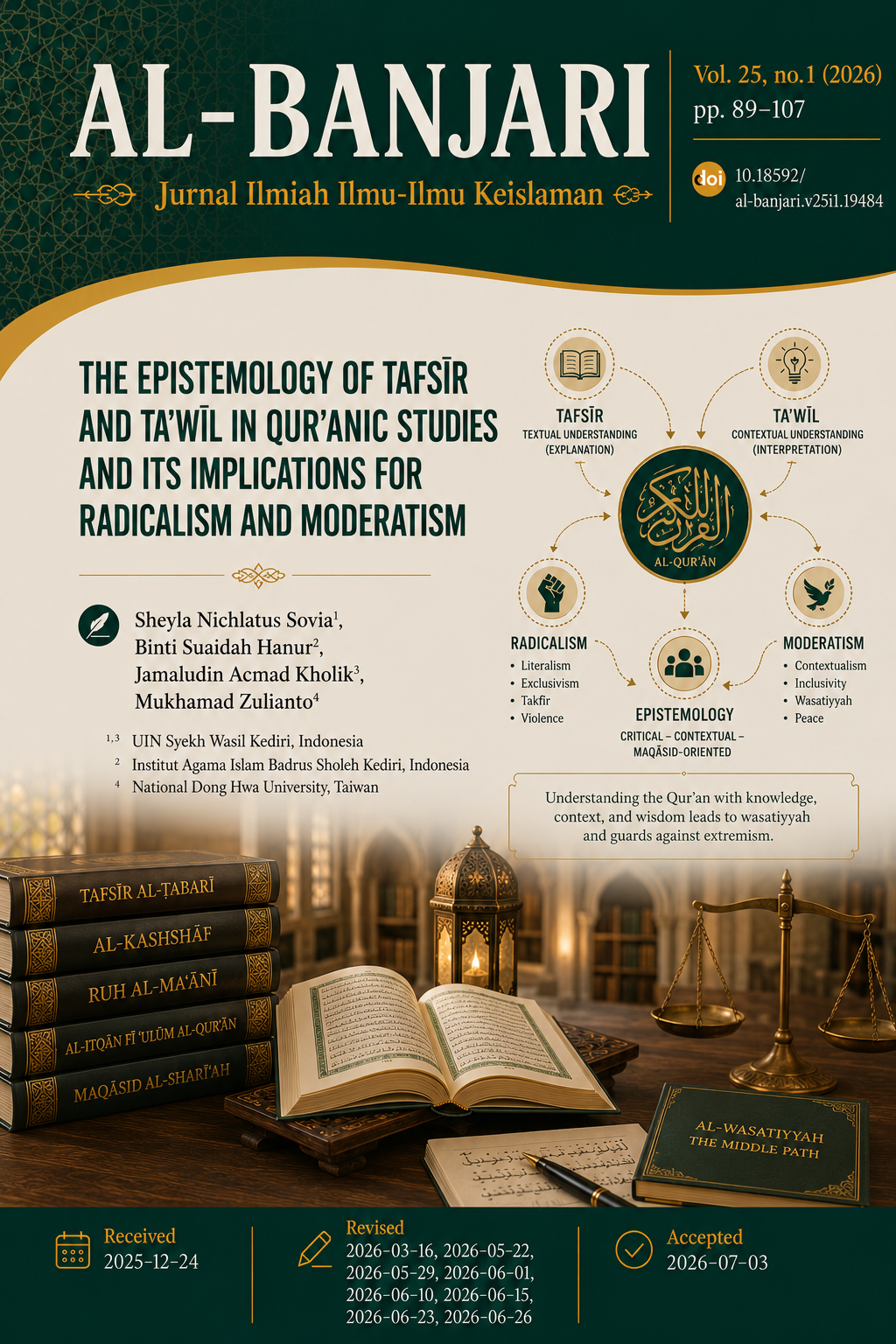
Contemporary religious radicalism is frequently associated with exclusive interpretations of the Qur’an, particularly when scriptural texts are detached from their historical and interpretive contexts. This phenomenon raises an important epistemological question concerning how different models of Qur’anic interpretation shape religious orientations in contemporary Muslim societies. This study examines the epistemological relationship between tafsīr and ta’wīl and analyzes its implications for contemporary debates on radicalism and religious moderation. Employing a qualitative library-based approach, the research combines content analysis and epistemological discourse analysis of classical and contemporary exegetical literature. Particular attention is given to the interpretation of Q. al-Tawbah [9]:5 as a representative case through which competing interpretive paradigms can be examined. The analysis focuses on sources of interpretive authority, the role of reason, contextualization, and maqāṣid al-sharī‘ah in the construction of Qur’anic meaning. The findings demonstrate that radical or moderate religious orientations do not emerge directly from the Qur’anic text itself, but are shaped by the epistemological frameworks through which the text is interpreted. While literal-textual approaches may contribute to exclusivist tendencies when detached from historical and ethical considerations, contextual and maqāṣid-oriented approaches provide broader space for interpretive plurality and ethical engagement. The study argues that tafsīr and ta’wīl should be understood as complementary rather than opposing paradigms and proposes an integrative epistemological model based on the interaction of riwāyah, dirāyah, and maqāṣid. This model offers a conceptual contribution to contemporary Qur’anic studies and provides a framework for strengthening religious moderation in plural societies.
Downloads
Published
Issue
Section
License
Copyright (c) 2026 Sheyla Sovia, Binti Suaidah Hanur, Jamaludin Acmad Kholik, Mukhamad Zulianto

This work is licensed under a Creative Commons Attribution-ShareAlike 4.0 International License.
Authors who publish with this journal agree to the following terms:
- Authors retain copyright and grant the journal right of first publication with the work simultaneously licensed under a Creative Commons Attribution License that allows others to share the work with an acknowledgement of the work's authorship and initial publication in this journal.
- Authors are able to enter into separate, additional contractual arrangements for the non-exclusive distribution of the journal's published version of the work (e.g., post it to an institutional repository or publish it in a book), with an acknowledgement of its initial publication in this journal.
- Authors are permitted and encouraged to post their work online (e.g., in institutional repositories or on their website) prior to and during the submission process, as it can lead to productive exchanges, as well as earlier and greater citation of published work (See The Effect of Open Access).






 This work is licensed under a