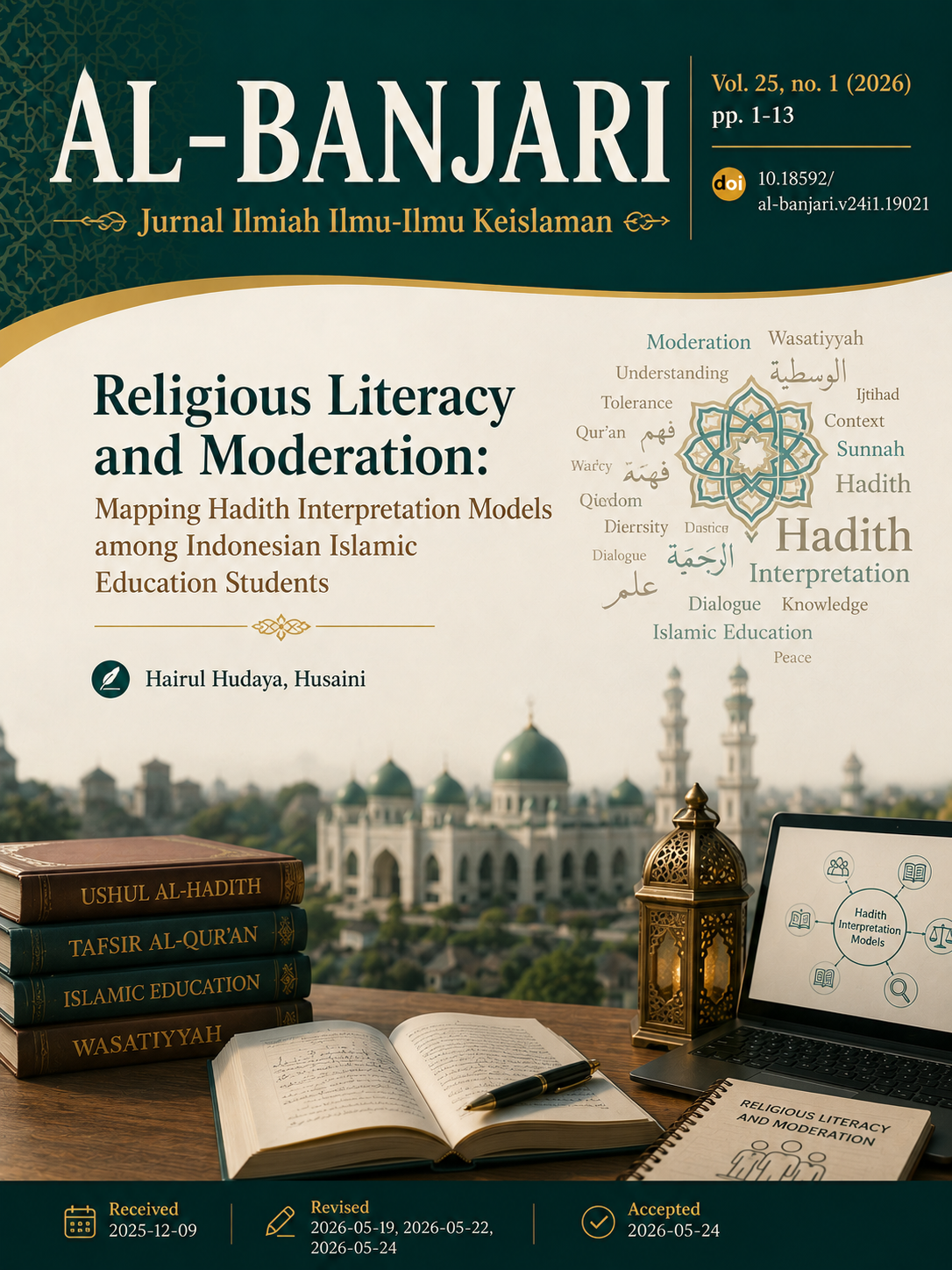
Religious Literacy and Moderation: Mapping Hadith Interpretation Models among Indonesian Islamic Education Students
DOI:
https://doi.org/10.18592/al-banjari.v24i1.19021Abstract
This article aims to map students' understanding of hadiths that contain counter-moderation content. Three aspects of moderation that are the focus of this study include: national commitment, tolerance, anti-violence, and adaptation to local culture. The main focus of the study is directed at three things, namely students' understanding of hadiths, the understanding model used, and their level of Islamic literacy. This research is field research with a qualitative approach. Data was collected from fifth-semester students at the Faculty of Tarbiyah and Teacher Training (FTK) through in-depth interviews. Respondents were asked to read and understand a number of hadiths with anti-moderation nuances (along with their translations) that had been prepared by the researcher. The researchers then explored how they understood the meaning and context of these hadiths. The collected data were then classified and analyzed based on the research questions. The results showed that the students' thinking tended to be very moderate, with a contextual understanding model, especially towards hadiths that, according to common sense, contradicted state law. Meanwhile, towards hadiths that did not conflict with national legal values, students tended to use a textual approach. However, the students' level of Islamic literacy was relatively low, as indicated by the lack of literary references in the arguments they presented. Based on these findings, the study recommends that stakeholders integrate specific material on religious moderation into the student learning curriculum.
Downloads
Published
Issue
Section
License
Copyright (c) 2026 Hairul Hudaya, Husaini Husaini

This work is licensed under a Creative Commons Attribution-ShareAlike 4.0 International License.
Authors who publish with this journal agree to the following terms:
- Authors retain copyright and grant the journal right of first publication with the work simultaneously licensed under a Creative Commons Attribution License that allows others to share the work with an acknowledgement of the work's authorship and initial publication in this journal.
- Authors are able to enter into separate, additional contractual arrangements for the non-exclusive distribution of the journal's published version of the work (e.g., post it to an institutional repository or publish it in a book), with an acknowledgement of its initial publication in this journal.
- Authors are permitted and encouraged to post their work online (e.g., in institutional repositories or on their website) prior to and during the submission process, as it can lead to productive exchanges, as well as earlier and greater citation of published work (See The Effect of Open Access).






 This work is licensed under a