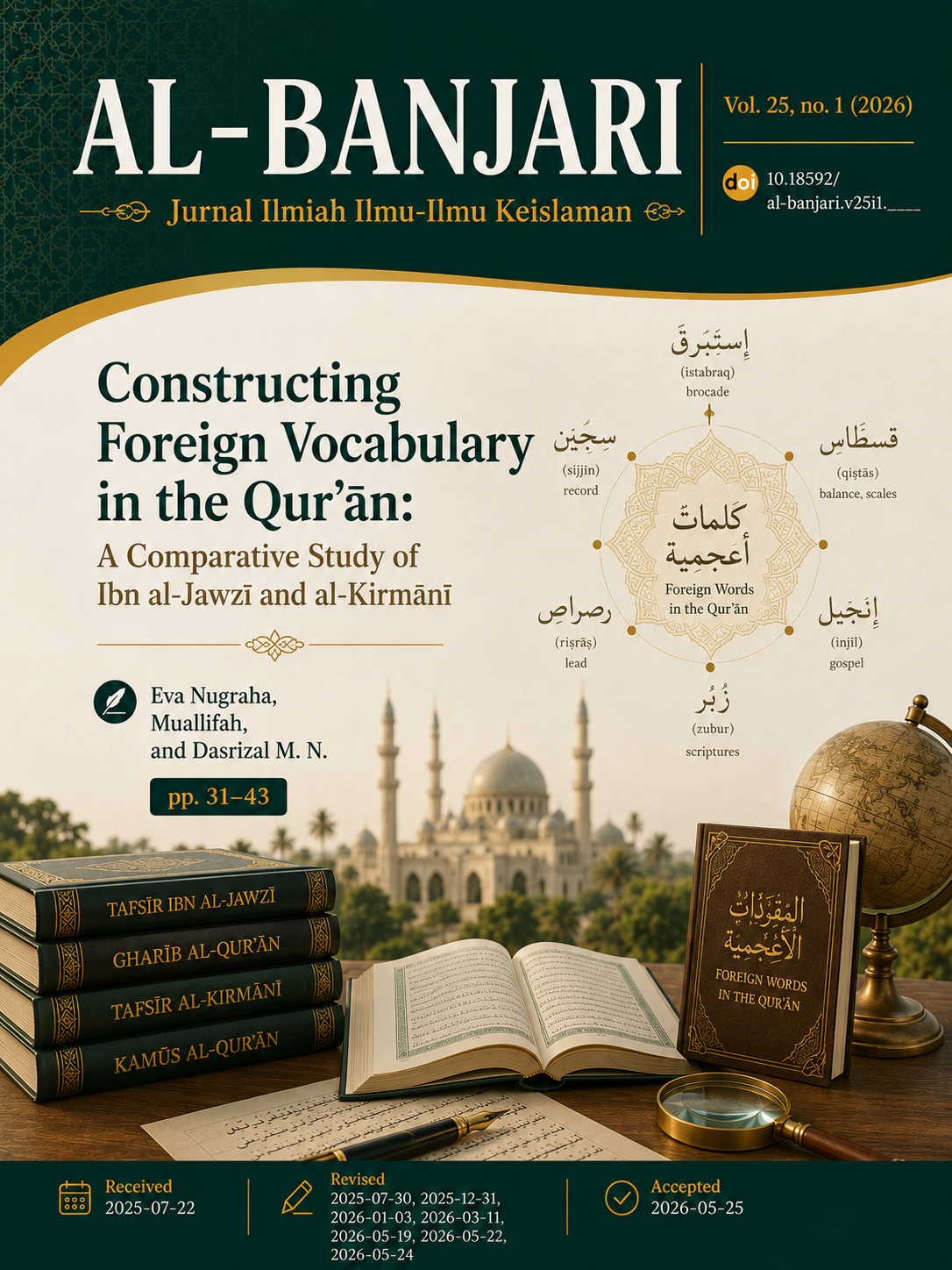
Constructing Foreign Vocabulary in the Qurʾān: A Comparative Study of Ibn al-Jawzī and al-Kirmānī
DOI:
https://doi.org/10.18592/al-banjari.v25i1.17780Abstract
This article examines the contested issue of the existence of foreign elements in the Qurʾān, with particular attention to the interpretive frameworks of Ibn al-Jawzī and al-Kirmānī. The debate represents a persistent intellectual tension between claims of linguistic purity and historical processes of language contact, making it a crucial site for understanding the epistemological construction of Qurʾānic language. While classical scholars such as al-Shāfi‘ī and Ibn Fāris emphasize the absolute Arabness of the Qurʾān, others acknowledge the presence of non-Arabic elements that have undergone processes of Arabization (taʿrīb). This study situates itself within this debate by proposing a comparative hermeneutical analysis to map how foreign vocabulary is conceptualized, categorized, and legitimized within classical tafsīr traditions. Using a qualitative library-based approach, the research employs comparative hermeneutics and structural analysis to examine the interpretive strategies of both scholars and to identify their underlying linguistic assumptions. The findings demonstrate that both Ibn al-Jawzī and al-Kirmānī recognize the historical existence of foreign-origin vocabulary in the Qurʾān but reinterpret such elements through the framework of Arabization, thereby preserving the doctrinal claim of ʿarabiyy mubīn. However, their approaches differ significantly: Ibn al-Jawzī tends to integrate linguistic, lexicographical, and historical arguments, while al-Kirmānī emphasizes classificatory and semantic distinctions rooted in the concept of ʿajam. This study argues that the discourse on foreign vocabulary in the Qurʾān is not merely a linguistic issue but reflects broader epistemological negotiations between textual authority, linguistic identity, and historical context. Accordingly, the concept of Arabization serves as a mediating framework that reconciles apparent contradictions between linguistic purity and historical plurality. The study contributes to Qurʾānic studies by offering a structured analytical model for understanding classical linguistic debates and their implications for contemporary hermeneutics.
Downloads
Published
Issue
Section
License
Copyright (c) 2026 Eva Nugraha, Muallifah Muallifah, Dasrizal M. N.

This work is licensed under a Creative Commons Attribution-ShareAlike 4.0 International License.
Authors who publish with this journal agree to the following terms:
- Authors retain copyright and grant the journal right of first publication with the work simultaneously licensed under a Creative Commons Attribution License that allows others to share the work with an acknowledgement of the work's authorship and initial publication in this journal.
- Authors are able to enter into separate, additional contractual arrangements for the non-exclusive distribution of the journal's published version of the work (e.g., post it to an institutional repository or publish it in a book), with an acknowledgement of its initial publication in this journal.
- Authors are permitted and encouraged to post their work online (e.g., in institutional repositories or on their website) prior to and during the submission process, as it can lead to productive exchanges, as well as earlier and greater citation of published work (See The Effect of Open Access).






 This work is licensed under a