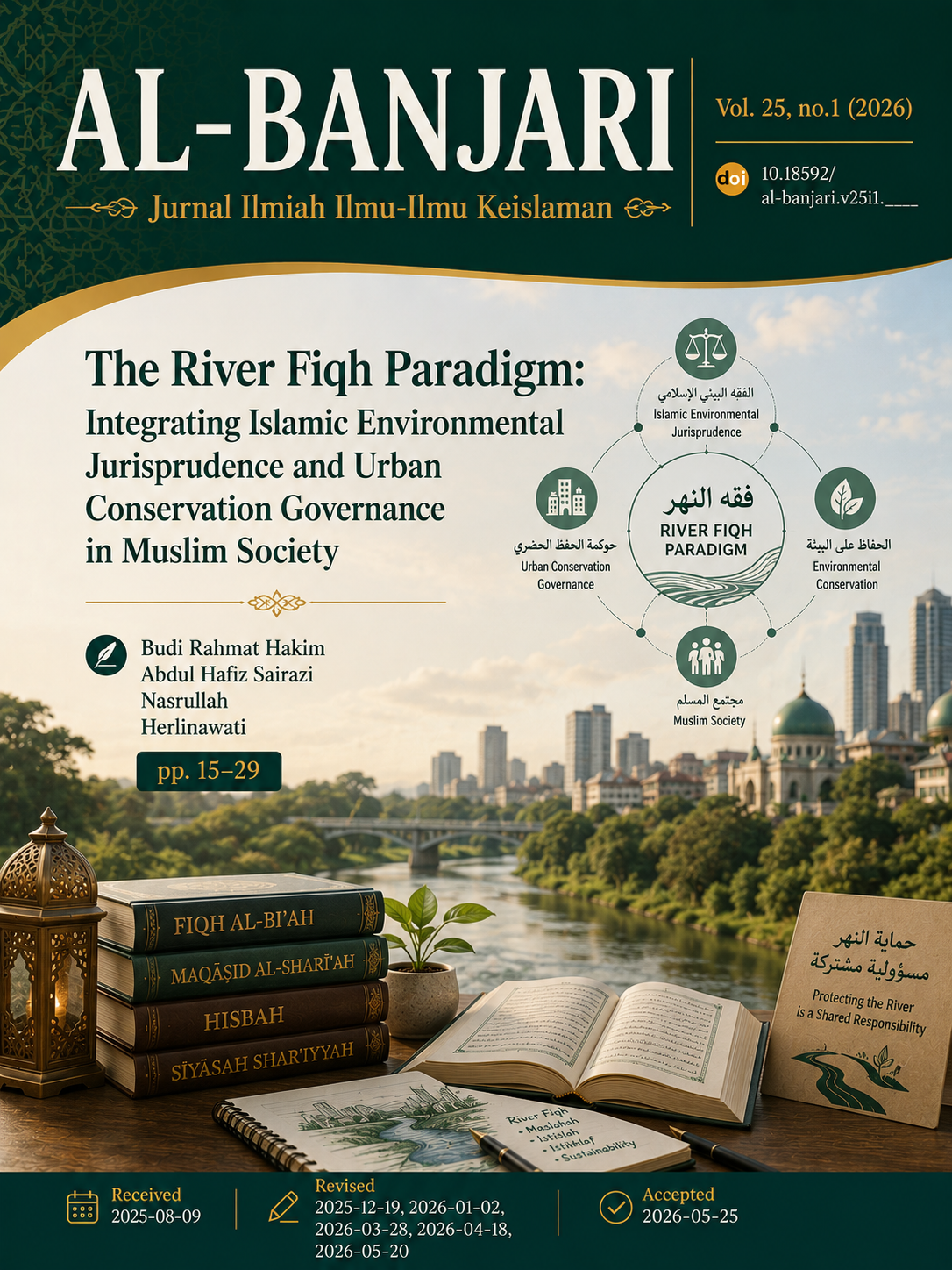
The River Fiqh Paradigm: Integrating Islamic Environmental Jurisprudence and Urban Conservation Governance in Muslim Society
DOI:
https://doi.org/10.18592/al-banjari.v25i1.15587Abstract
River degradation in Muslim-majority urban areas has become a critical challenge for both environmental governance and Islamic ethical responsibility. Despite the existence of conservation policies and religious teachings concerning environmental stewardship, river pollution and riverbank encroachment continue to intensify in Banjarmasin, Indonesia, widely known as the “City of a Thousand Rivers.” This study examines the effectiveness of government river conservation policies, community participation, and Muslim religious understanding regarding Islamic environmental jurisprudence in river conservation practices. Employing a qualitative socio-legal approach, the study collected data through in-depth interviews with riverbank communities, government officials from the Public Works and Spatial Planning Agency and the Environmental Agency, field observation, and policy document analysis. The findings reveal that although river conservation has been institutionally incorporated into regional spatial planning frameworks and implemented through revitalization programs, policy effectiveness remains constrained by weak public participation, limited environmental awareness, and inadequate understanding of Islamic legal principles related to ecological responsibility. Most community members only recognize general prohibitions against littering while lacking deeper understanding of Islamic concepts such as maslahah, maqāṣid al-sharī‘ah, and harim al-nahar as ethical foundations for river conservation. The study argues that the gap between formal policy implementation and ecological behavior cannot be addressed solely through regulatory mechanisms, but requires the integration of Islamic environmental jurisprudence into community-based conservation strategies. This article proposes the “River Fiqh Paradigm” as an integrative framework that bridges Islamic legal ethics, environmental governance, and urban conservation policy in Muslim societies. The study contributes theoretically to the discourse on Islamic environmental governance by demonstrating how religious values can strengthen sustainable conservation practices and public ecological responsibility in contemporary Muslim urban contexts.
Downloads
Published
Issue
Section
License
Copyright (c) 2026 Budi Rahmat Hakim, Abdul Hafiz Sairazi, Nasrullah Nasrullah, Herlinawati Herlinawati

This work is licensed under a Creative Commons Attribution-ShareAlike 4.0 International License.
Authors who publish with this journal agree to the following terms:
- Authors retain copyright and grant the journal right of first publication with the work simultaneously licensed under a Creative Commons Attribution License that allows others to share the work with an acknowledgement of the work's authorship and initial publication in this journal.
- Authors are able to enter into separate, additional contractual arrangements for the non-exclusive distribution of the journal's published version of the work (e.g., post it to an institutional repository or publish it in a book), with an acknowledgement of its initial publication in this journal.
- Authors are permitted and encouraged to post their work online (e.g., in institutional repositories or on their website) prior to and during the submission process, as it can lead to productive exchanges, as well as earlier and greater citation of published work (See The Effect of Open Access).






 This work is licensed under a